Quick answer
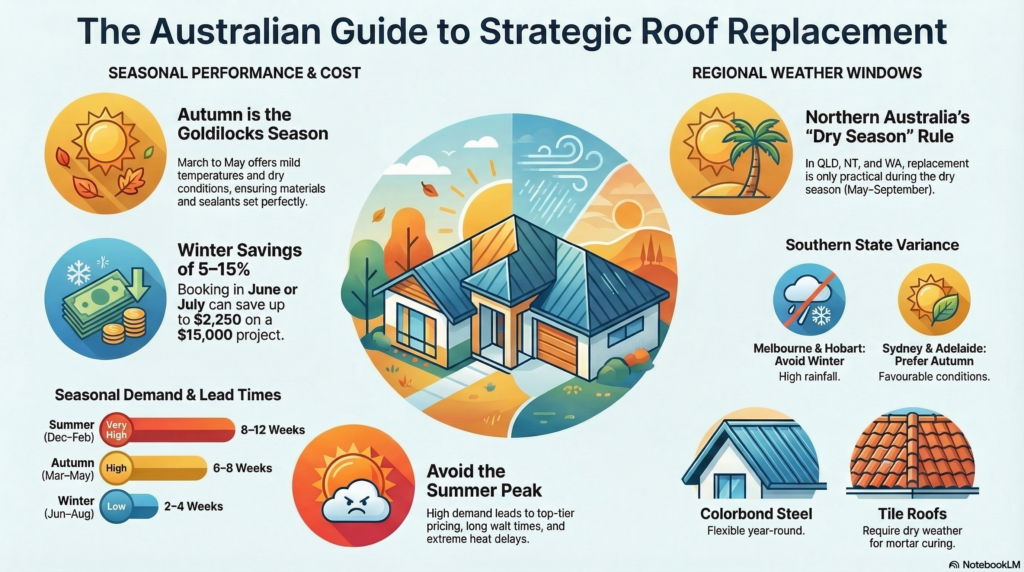
Autumn (March to May) is the best time of year to replace a roof for most Australians — mild weather, dry conditions, and a good run before winter. If saving money is your priority, winter (June to July) is the cheapest time, with potential savings of 5–15%. In northern Australia (QLD, NT), winter is the only practical option due to the wet season.
In this article
- Why timing matters for roof replacement
- Season-by-season breakdown for Australia
- State-by-state guide
- Cheapest time of year to replace a roof
- When to book your roofer
- What to avoid when timing your roof job
- Tips to save money on roof replacement
- Frequently asked questions
Why Timing Matters When Replacing a Roof
Replacing a roof is one of the biggest roofing projects you’ll ever undertake. And unlike a kitchen renovation or a fresh coat of paint, the weather outside has a direct impact on how well the job goes — and how much it costs.
Get the timing right, and you’ll enjoy better pricing, faster scheduling, and a higher quality finish. Get it wrong, and you could face weather delays, rushed workmanship, and a longer wait just to get a roofer on-site.
There are three main reasons timing matters:
- Weather conditions — Rain, extreme heat, and wind all affect how safely and effectively a new roof can be installed.
- Contractor availability — Roofing is a seasonal trade. During peak periods, the best roofers are fully booked weeks or months in advance.
- Cost — Prices fluctuate with demand. Replace your roof in off-peak months and you can often negotiate a better deal.
The good news? Australia has a climate that allows for roof replacement in almost every season — you just need to know which season works best for your state.
Season-by-Season Breakdown for Australia
Let’s look at each season honestly — the good, the bad, and the practical truth for Australian homeowners.
🏆 Best🍂
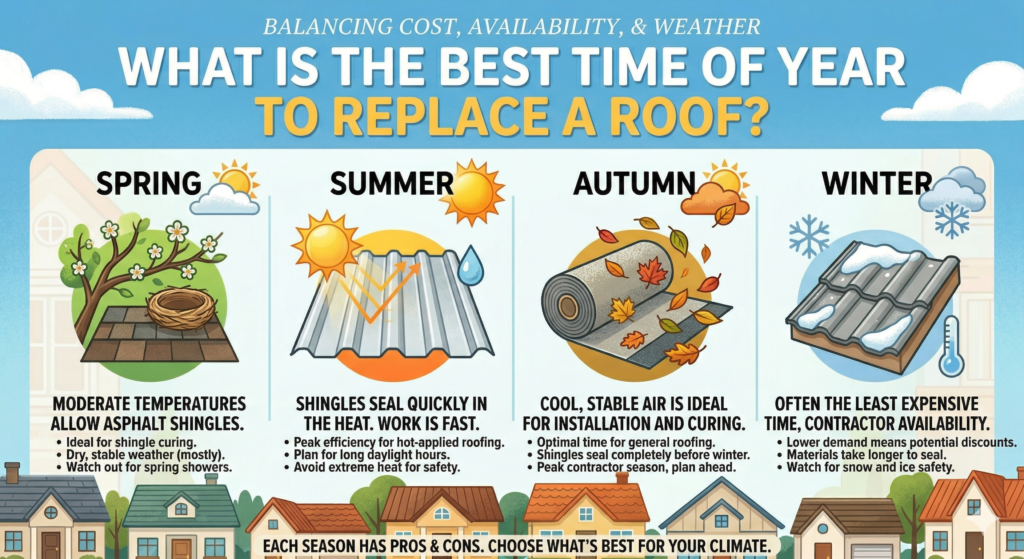
Autumn — March to May
Best overall for most Australian homes
Mild temperatures, lower rainfall, and dry conditions. Materials set well. Your home is protected well before winter rains arrive. The most recommended season by Australian roofers.
💰 Cheapest❄️
Winter — June to August
Best for saving money
Lowest demand = better prices and faster scheduling. Australian winters are mild and dry in most states. June and July are the cheapest months to get a roof replaced nationally.
✅ Great🌱
Spring — September to November
Excellent — second best overall
Fresh off winter, roofers are available and pricing is still reasonable. Watch for spring storms in South East Australia in October-November. Book early as spring fills up fast.
⚠ Avoid☀️
Summer — December to February
Most expensive and busiest period
Peak demand means top prices and long wait times. Extreme heat (40°C+) slows crews. Wet season across northern Australia makes scheduling very difficult from November to April.
How Does Each Season Affect the Actual Roof Installation?
It’s not just about pricing. The weather itself can affect the quality and safety of your new roof. Here’s what experienced Australian roofers look for:
| Condition | Effect on Installation | Season Affected |
|---|---|---|
| Extreme heat (38°C+) | Metal sheets become very hot to handle. Adhesives can set too quickly. Crew fatigue increases. | Summer (especially QLD, NT, WA) |
| Heavy rain | Work must stop. Exposed roof decking can be damaged. Schedule delays add up fast. | Summer (northern AU), Spring storms (SE AU) |
| Mild temps (15–25°C) | Ideal for all roof types. Crews work efficiently. Sealants and adhesives set correctly. | Autumn and Spring |
| Cool, dry conditions | Perfectly workable. Colorbond and tile install well. No overheating issues. | Winter (most southern states) |
| Strong winds | Sheet metal and tiles must be secured immediately. Safety risk for crews working at height. | Watch for in all seasons — check forecasts |
💡 Good to know
Colorbond steel — Australia’s most popular roofing material — is the most flexible across seasons. It can be installed safely in most conditions. Tile roofs (concrete and terracotta) are more sensitive to very wet or very cold conditions, as mortar and bedding compounds need dry weather to cure properly.
State-by-State Guide — Best Time to Replace Your Roof
Australia is a big country with very different climates. The “best season” for a Sydney homeowner is completely different from what a Darwin or Brisbane homeowner needs to consider. Here’s a practical breakdown by state and region:
| State / Region | Best Time to Replace | Avoid | Key Reason |
|---|---|---|---|
| Sydney / NSW | Autumn (Mar–May) or Spring | Peak summer (Dec–Feb) | Mild dry autumn; spring can bring storms |
| Melbourne / VIC | Autumn (Mar–Apr) | Winter (very wet in VIC) | Melbourne’s wet winters make scheduling difficult |
| Brisbane / QLD | Winter (Jun–Aug) | Nov–Apr (wet season + storms) | Dry mild winters are ideal; summer is wet and stormy |
| Perth / WA | Spring (Sep–Nov) | Winter (wet season WA) | Perth winters are the rainiest; spring is dry and mild |
| Adelaide / SA | Autumn or Spring | Summer extremes (40°C+) | Extreme SA heat in summer; autumn and spring are mild |
| Darwin / NT | Dry season (May–Sep) only | Oct–Apr (wet season) | Wet season brings 1,500mm+ rainfall — not workable |
| Cairns / Far North QLD | Dry season (Apr–Sep) | Nov–Mar (tropical wet season) | Cyclone risk + heavy rainfall make wet season impossible |
| Hobart / TAS | Summer (Jan–Feb) | Winter (coldest + wettest) | Tasmania’s mild summer is the only reliable dry window |
| ACT / Canberra | Autumn (Mar–May) | Winter (frosts, cold) | Canberra winters include frosts that affect mortar setting |
⚠ Northern Australia — plan very early
If you live in Darwin, Cairns, or anywhere in the tropical north, your window for roof replacement is essentially limited to the dry season (May to September). Every roofing contractor in these regions gets fully booked during this period. Start planning and getting quotes at least 3 to 4 months in advance — ideally in February or March.
Cheapest Time of Year to Replace a Roof in Australia
Let’s talk money. Roof replacement is expensive — if you want to understand the full cost breakdown first, read our guide on roof repair costs in Australia. But if you’re ready to replace, here’s when it will cost you the least.
The answer is June and July — the middle of winter in most Australian states. Here’s why:
- Fewer homeowners are booking roof jobs in winter — demand drops noticeably after the summer rush
- Roofing contractors have more open slots in their schedule, which gives you more negotiating power
- Some contractors offer quiet-season discounts to keep their crews working through winter
- Material suppliers may also have slightly better lead times, reducing delays
5–15% Typical savings in off-peak season
Australian homeowners who book roof replacement in June–July (vs peak summer) can typically save between 5% and 15% on total project cost — on a $15,000 roof job, that’s $750 to $2,250 back in your pocket.
Is Winter Quality the Same as Summer?
Yes — in most parts of Australia, absolutely. Professional roofers work to the same standards year-round. The key is choosing the right days within winter, not avoiding winter altogether.
A good roofer will check the forecast and schedule your job during a dry, calm weather window. For Colorbond metal roofing — by far the most common roof type in Australia — winter installation is perfectly fine in NSW, QLD, SA, WA, and the ACT. Victoria and Tasmania require a bit more planning around rainy days.
📌 Budget tip
When getting quotes, always mention that you’re flexible on timing and willing to work around the contractor’s schedule. Contractors who have a gap in their winter diary may be willing to pass on savings to fill the slot — especially if you can confirm quickly.
When Should You Book a Roofer in Australia?
Knowing the best season is only half the equation. Knowing when to book is just as important — especially since Australia’s best roofers get booked out weeks or months ahead during peak periods. Browse our roofing guides to understand what to look for when comparing quotes.
| Target Season | When to Start Booking | Demand Level |
|---|---|---|
| Summer (Dec–Feb) | 8–12 weeks before your target date | Very High — fully booked fast |
| Autumn (Mar–May) | 6–8 weeks ahead | High — most popular season |
| Winter (Jun–Aug) | 2–4 weeks ahead | Low — best availability |
| Spring (Sep–Nov) | 4–6 weeks ahead | Moderate to High |
The smartest approach is to get your inspection and quotes done 2 to 3 months before you want the work started. This gives you time to compare at least two or three quotes, check contractor reviews and licences, and lock in a start date without feeling rushed.
✅ Pro tip — plan around selling or renovating
If you’re planning to sell your home, aim to have your new roof completed at least 4 to 6 weeks before you list the property. This gives time for any minor touch-ups, and allows you to include a “new roof installed [month/year]” in your marketing — which is a genuine selling point that buyers and conveyancers notice.
What to Avoid When Timing Your Roof Replacement
Just as important as knowing the best time is knowing when not to replace your roof — or at least, when to be extra careful. Here are the most common timing mistakes Australian homeowners make:
- Waiting until after the wet season starts. If your roof is already damaged and the wet season is approaching (especially in QLD and NT), don’t delay. An emergency repair mid-wet-season is far more expensive and disruptive than getting the job done in the dry season.
- Booking a peak-season job with no lead time. Calling a roofer two weeks before Christmas and expecting to get on their schedule is unrealistic. You’ll either get turned away or end up with whoever has last-minute availability — and that’s rarely the best outcome.
- Ignoring your local climate. A blanket recommendation like “autumn is best” doesn’t work for Darwin or Cairns. Always match your timing decision to your specific state and region.
- Delaying a needed replacement for a “cheaper season.” If your roof is actively leaking, structurally compromised, or missing significant tiles — don’t wait for winter to save a few hundred dollars. The water damage from delaying will cost far more than any seasonal savings.
- Not checking contractor licensing. In the rush of booking during a good weather window, some homeowners skip checking that their roofer is properly licensed. In Australia, all roof work should be done by a licensed builder or roofing contractor — always verify through your state’s building authority before signing.
Tips to Save Money on Roof Replacement in Australia
Beyond choosing the right season, there are several other practical ways to reduce the cost of your roof replacement without cutting corners on quality:
Get at least three quotes
Never accept the first quote you receive. Getting three quotes from licensed roofers in your area gives you a realistic price range and real negotiating leverage. Don’t just go for the cheapest — check what’s included in each quote (materials, labour, disposal, gutters, flashing).
Be flexible with your schedule
Telling a contractor “I’m flexible on the exact date — whatever works for your schedule” is genuinely useful to them. Many roofers will offer a small discount to fill gaps in their calendar, especially in winter. Even a willingness to start on short notice can work in your favour.
Ask about material offcuts and stock
Some roofing contractors carry surplus stock of Colorbond or tile from previous jobs. If the colour and style suits your home, using in-stock materials can save you on lead times and sometimes on cost too. Always ask.
Bundle roofing with gutter and fascia work
If your gutters and fascias also need attention, getting it all done in one project visit saves on call-out fees and labour time. If you’re also planning a broader renovation, our home builders guide covers how to coordinate multiple trades efficiently. Many roofing contractors in Australia offer combined roof, gutter, and downpipe packages — ask for a bundled quote.
Check if you’re eligible for insurance coverage
If your roof was damaged by a storm, hail event, or bushfire, your home insurance may cover part or all of the replacement cost. Check your policy and lodge a claim before booking any work. Your insurer may also have preferred contractors who can process claims more efficiently.
⚠ A word of warning
Be cautious of unsolicited roofing offers — especially after a major hailstorm. Door-to-door roofers who appear after a weather event and promise fast, cheap repairs are a common scam in Australia. Always independently verify any contractor’s licence through your state’s building regulator before signing anything or making any payment.
Frequently Asked Questions
Final Thoughts
The best time of year to replace a roof in Australia isn’t a one-size-fits-all answer — it depends on where you live, what your roof is made of, and whether you’re prioritising quality conditions or the lowest cost.
For most Australians, autumn ticks every box — great weather, good contractor availability, and solid preparation for winter. If budget is your main concern, June or July is your best bet for saving money without compromising on the quality of the work.
Whatever time of year you choose, the most important things are simple: get multiple quotes from licensed roofers, don’t delay if your roof is already damaged, and plan ahead so you’re not scrambling for availability at the worst possible time.
A new roof is a long-term investment in your home. Get the timing right, and it will protect your family for the next 40 to 70 years.