Real prices for every home size, every room, and every Australian city. No vague estimates – just the numbers you actually need to budget your next paint job.
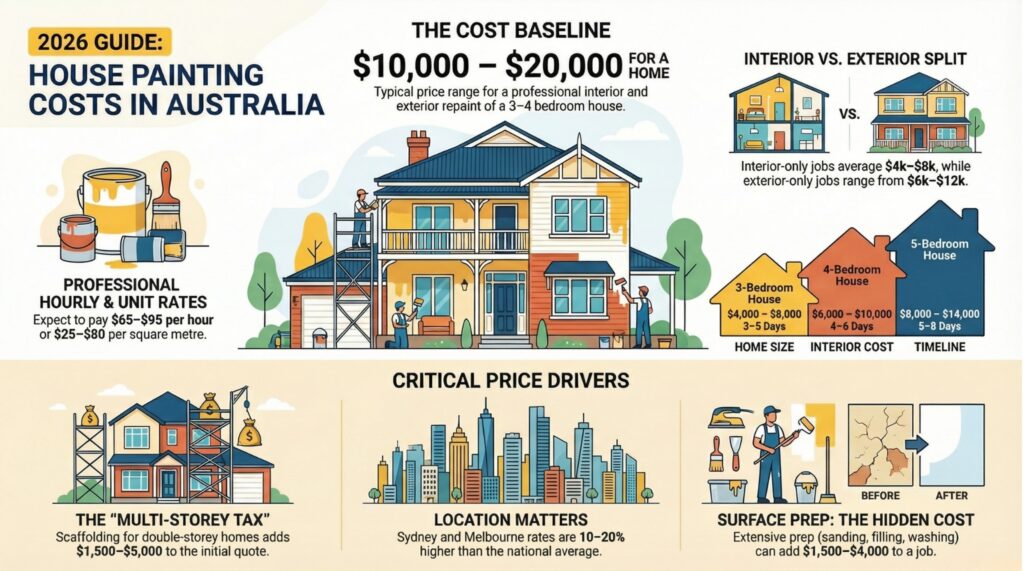
Painting a full 3–4 bedroom house in Australia costs between $10,000 and $20,000 for interior and exterior combined. Interior-only jobs run $4,000–$8,000 and exterior-only $6,000–$12,000 for a single-storey home. Painters charge $65–$95 per hour or $25–$80 per square metre depending on the surface and access. Prices are higher in Sydney and Melbourne and lower in regional areas.
What’s in this guide
- 8 factors that affect painting cost
- Cost by house size
- Cost per room breakdown
- Exterior house painting cost
- Cost per square metre
- City-by-city price comparison
- DIY vs professional – honest comparison
- How to save money on your paint job
- What should be in your painting quote
- Frequently asked questions
If you’ve ever asked a painter for a quote and wondered why two quotes for the same house can differ by $5,000 – you’re not alone. House painting costs in Australia can vary enormously, and the gap between the cheapest and most expensive quotes is rarely about the paint itself.
This guide breaks down exactly what you’ll pay, what drives the price up (or down), and how to get the best possible result for your budget. We’ve used real 2026 Australian pricing data throughout, so these aren’t US numbers recycled for an Australian audience.
Section 01
8 Factors That Affect the Cost of Painting a House in Australia
Before we get into specific price ranges, it helps to understand what actually drives the cost of a paint job. Ask any licensed painter in Australia and they’ll tell you the same thing: no two houses are priced the same, because no two houses are the same.
| 01. Size of the home More square metres = more paint and more labour hours. This is the single biggest cost driver. | 02. Single vs double storey Two-storey homes require scaffolding, which adds $1,500–$5,000 to the job before a brush is lifted. |
| 03. Condition of surfaces Peeling paint, cracks, mould, and water damage all require prep work. Surface prep is the most time-consuming part of any quality paint job. | 04. Wall material Weatherboard is more complex to paint than smooth rendered walls. Rough surfaces absorb more paint and take longer to coat properly. |
| 05. Colour change Going from a dark colour to a light one (or vice versa) needs extra coats of paint – adding $800–$1,500 to the job. | 06. Ceiling height High ceilings (3m+) add 30–40% to labour costs for the ceiling area. Federation and heritage homes are most affected. |
| 07. Your location Sydney and Melbourne painters charge 10–20% more than regional areas due to higher labour and living costs. | 08. Paint quality chosen Premium paints like Dulux Wash & Wear cost 40–60% more than budget options – but last significantly longer, meaning you repaint less often. |
💡 Important to know
Surface preparation is the biggest hidden cost in painting. A painter who gives you a cheap quote may be skimping on prep – washing, sanding, filling cracks, and priming. Skipping prep always leads to peeling and bubbling within 2–3 years. Always ask what prep work is included in every quote you receive. You can also learn more about what professional trades include in a home improvement project on our home builder guide.
Section 02
House Painting Cost by Home Size in Australia
The easiest way to get a rough budget figure is to start with the size of your home. Here are typical 2026 price ranges for different home sizes across Australia.
Interior Painting Costs by Home Size
| Home Size | Interior Only (Walls + Ceilings) | Add Trims & Doors | Timeline |
|---|---|---|---|
| 1-bedroom apartment | $1,800 – $3,500 | + $500–$800 | 1–2 days |
| 2-bedroom house / unit | $2,500 – $5,000 | + $600–$1,000 | 2–3 days |
| 3-bedroom house | $4,000 – $8,000 | + $800–$1,500 | 3–5 days |
| 4-bedroom house | $6,000 – $10,000 | + $1,000–$2,000 | 4–6 days |
| 5-bedroom house | $8,000 – $14,000 | + $1,500–$3,000 | 5–8 days |
Exterior Painting Costs by Home Size
| Home Type | Exterior Cost (Walls Only) | Add Eaves, Trims & Doors | Scaffolding Needed? |
|---|---|---|---|
| Single-storey brick | $5,000 – $9,000 | + $1,000–$2,000 | Usually no |
| Single-storey weatherboard | $6,000 – $12,000 | + $1,000–$2,500 | Possibly |
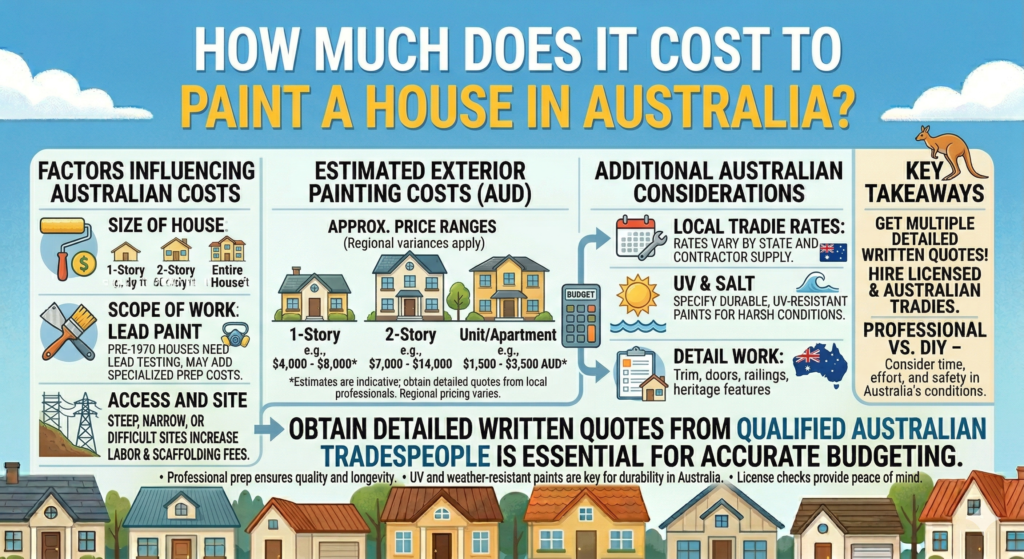
| Double-storey brick | $9,000 – $16,000 | + $1,500–$3,000 | Yes – add $1,500–$3,500 |
| Double-storey weatherboard | $12,000 – $20,000+ | + $2,000–$4,000 | Yes – add $2,500–$5,000 |
⚠ Watch out for this
Scaffolding is one of the most underquoted costs in exterior painting. Some painters don’t include it in their initial quote to make the number look lower – then add it later. Always ask your painter upfront: “Is scaffolding included in this quote?” For double-storey homes, it’s almost always required. Safe Work Australia requires working-at-height safety measures on all residential jobs above 2 metres.
Section 03
Painting Cost Per Room in Australia
If you’re only painting certain rooms – not the whole house – here’s what to expect per room in 2026. These figures are for professional labour and materials combined, and assume standard ceiling heights (2.4–2.7m) and good surface condition.
| Room | Typical Size | Cost (Walls + Ceiling) | Add Trims |
|---|---|---|---|
| Bedroom (small) | 3m × 3.5m | $400 – $750 | + $150–$300 |
| Bedroom (master / large) | 4m × 4.5m+ | $800 – $1,500 | + $200–$400 |
| Bathroom | 2m × 3m | $150 – $350 | + $100–$200 |
| Kitchen | 3m × 4m | $300 – $1,000 | + $150–$300 |
| Living / dining room | 5m × 6m+ | $900 – $2,000 | + $300–$600 |
| Hallway / corridor | 1.2m × 6m | $300 – $700 | + $150–$300 |
| Feature wall only | Single wall | $150 – $400 | – |
| Garage (interior walls) | Varies | $400 – $900 | + $150–$250 |
📌 Tip – painting before a kitchen or bathroom renovation
If you’re planning a bathroom renovation or kitchen renovation, always paint first – before new fixtures, tiles, or cabinetry goes in. It’s faster, cheaper (no masking around new fittings), and gives you a much cleaner result. Painting after a renovation runs 20–30% higher in cost due to the extra masking and protection work required.
Section 04
Exterior House Painting Cost in Australia
Exterior painting is a bigger job than most homeowners expect. It’s not just about slapping paint on walls – it involves pressure washing, repairing cracks and holes, priming bare areas, and applying at least two coats of weather-resistant paint. That’s why exterior jobs typically cost more per square metre than interior ones.
| Exterior per sqm $30–$80 Depends on surface & height | Average 3-bed exterior $6K–$12K Single storey, good condition | Scaffolding add-on $1.5K–$5K Required for 2-storey homes | Roof painting $2.8K–$4.5K Metal, tile or terracotta |
What Material Is Your Exterior Wall?
The type of wall surface on the outside of your home significantly affects cost. Here’s a quick breakdown:
| Wall Material | Cost per Sqm | Why It Varies |
|---|---|---|
| Smooth rendered / cement | $20–$40 | Quick to paint, minimal absorption |
| Brick (painted surface) | $25–$50 | Porous – absorbs more paint |
| Weatherboard / timber | $40–$70 | Complex profiles, more detailed work |
| Fibre cement (Hardiflex) | $35–$60 | Primer coat always required |
| Rough texture / bagging | $50–$80 | High paint consumption |
| Heritage home (ornate trim) | $70–$120+ | Detailed brush work, lead paint testing |
⚠ Lead paint — important for older homes
If your home was built before 1970, there’s a real chance your existing paint contains lead. Lead paint must be handled and disposed of by a licensed contractor under Safe Work Australia guidelines. Lead testing kits cost around $20–$50 from hardware stores. Professional lead paint testing and removal adds approximately $1,500–$4,000 to the job depending on the extent. Never sand or scrape suspected lead paint without testing first.
Section 05
House Painting Cost Per Square Metre in Australia
Many painters in Australia quote by the square metre rather than hourly — especially for larger jobs. Here’s a comprehensive reference table so you can sanity-check any quote you receive.
| Surface Type | Cost Per Sqm | Coats Included | Notes |
|---|---|---|---|
| Interior walls (standard) | $25–$35 | 1 undercoat + 2 topcoats | Smooth, good condition |
| Interior walls (poor condition) | $35–$55 | Prep + 3 coats | Cracks, peeling, staining |
| Ceiling (standard) | $18–$30 | 1–2 coats ceiling white | Price rises with height |
| Exterior walls (rendered) | $30–$45 | Primer + 2 topcoats | Ground-level access |
| Exterior walls (weatherboard) | $45–$70 | Undercoat + 2 topcoats | All sides of boards |
| Exterior (2nd storey, scaffold) | $60–$90 | Full exterior spec | Includes scaffolding cost |
| $65–$95 Hourly rate for a licensed painter in Australia (2026) | $560–$760 Day rate per painter (excl. GST) | 6.21% Paint material cost increase since 2024 |
Section 06
House Painting Cost by City in Australia
Where you live in Australia has a real impact on what you’ll pay. Labour costs follow the cost of living, so Sydney and Melbourne are the most expensive markets, while regional cities and Queensland offer more competitive rates.
| City / Region | Hourly Rate | 3-Bed Interior (Full) | vs National Average |
|---|---|---|---|
| Sydney, NSW | $80 – $110 | $6,000 – $10,000 | +15–20% above average |
| Melbourne, VIC | $75 – $105 | $5,500 – $9,500 | +10–15% above average |
| Brisbane, QLD | $65 – $90 | $4,500 – $8,000 | Near national average |
| Perth, WA | $65 – $90 | $4,500 – $8,000 | Near national average |
| Adelaide, SA | $60 – $85 | $4,000 – $7,500 | 5–10% below average |
| Canberra, ACT | $70 – $95 | $5,000 – $8,500 | Slightly above average |
| Hobart, TAS | $60 – $82 | $4,000 – $7,000 | 5–10% below average |
| Regional areas (general) | $55 – $75 | $3,500 – $6,500 | 10–20% below average |
Section 07
DIY vs Professional Painting – Honest Cost Comparison
Thinking about doing it yourself to save money? It’s a genuine option for some situations. Here’s an honest look at both approaches – without the usual “just hire a professional” bias that most articles have.
| DIY Painting | Professional Painter | |
|---|---|---|
| Material cost (3-bed interior) | $1,500 – $3,000 | $1,500 – $3,500 (included in quote) |
| Labour cost | $0 (your time) | $3,000 – $6,500 |
| Total cost | $1,500 – $3,000 | $4,000 – $8,000 |
| Time required | 2–4 weekends | 3–5 days |
| Finish quality | Good (with care) | Excellent (consistent) |
| Longevity of result | 5–7 years (if prepped well) | 7–12 years |
| Right for you if… | Small rooms, fresh colour, decent surfaces | Full house, exterior, complex prep, selling soon |
When DIY Makes Sense
- You’re painting a single room or a feature wall
- The existing surface is in good condition – no peeling, cracks, or moisture damage
- You’re keeping the same or a similar colour (no dark-to-light drama)
- You have the time and enjoy DIY projects
- Standard ceiling heights (2.4m) – no ladders higher than a 6-step
When a Professional Is Worth Every Dollar
- Any exterior painting – preparation, access, and weatherproofing require expertise
- Your home has significant surface damage, peeling paint, or moisture issues
- You’re painting before selling – a professional finish adds real value
- Double-storey homes where ladders and scaffolding create safety risks
- Heritage or older homes where lead paint testing is needed
- You want the job done in days, not weeks
Section 08
How to Save Money on House Painting in Australia
There are smart ways to reduce your painting costs without compromising on the quality of the result. Here are the most effective strategies:
1. Get at Least Three Written Quotes
Never accept the first quote. Three quotes give you a realistic price range for your specific job and real negotiating power. According to CHOICE Australia, getting multiple quotes is one of the most effective ways to avoid overpaying for any trade work. Make sure all quotes are written, itemised, and cover the same scope of work.
2. Be Flexible With Your Timing
Painters are busiest in summer and early autumn. If you can book in June or July (quieter winter months), you often get better availability and more competitive pricing – sometimes 5–10% less than peak rates. We cover this in more detail in our guide on the best time of year for home improvement projects.
3. Do the Prep Yourself
Surface preparation – washing walls, filling small holes, sanding rough patches – is time-consuming but not technically difficult. If you do this yourself before the painter arrives, you can reduce their prep time and lower your labour bill by $300–$800 depending on the size of the job. Ask your painter in advance exactly what prep they expect to be done.
4. Stick to Similar Colours
Changing from a dark colour to a light one (or the reverse) requires extra coats of paint. If you can choose a new colour that’s similar in tone to the existing one, you’ll save on both paint materials and labour. Ask your painter what colours would require fewer coats over your existing walls.
5. Bundle Rooms Together
Painters charge a call-out component for every visit. Getting all your interior rooms painted in one go – rather than room by room over separate visits – saves significantly on the fixed travel and setup cost. Most painters offer a better rate per room when multiple rooms are booked together.
6. Supply Your Own Paint
Some painters are happy for you to supply your own paint, which removes their materials markup (typically 20–30% above retail). Dulux’s paint guide is a good resource for choosing the right product for your surface. Always confirm this arrangement with your painter before purchasing anything – they need to approve the product spec.
💰 Quick tip – pre-sale painting
If you’re painting before selling, don’t paint every room. Focus your budget on the rooms that matter most to buyers: the front facade (first impression), kitchen, living room, and master bedroom. A targeted refresh in these four areas typically delivers better return on investment than a full house repaint. Speak to your agent before booking – they know what buyers in your suburb respond to. You can explore more pre-sale improvement ideas in our home improvement guides.
Section 09
What Should Be Included in Your Painting Quote?
A professional painting quote in Australia should always be provided in writing. If a painter only offers a verbal quote, that’s a red flag. Here’s what every written quote should cover:
- Scope of work – which rooms, surfaces, and areas are included (and excluded)
- Surface preparation – washing, sanding, filling, priming — clearly itemised
- Paint brand and product – specific product name, not just “quality paint”
- Number of coats – undercoat + how many topcoats per surface
- Labour cost – separately from materials (so you can compare apples to apples)
- Materials cost – paint, primer, masking, drop sheets
- Scaffolding or access equipment – clearly stated whether included
- Waste disposal – old paint and materials removed at job completion
- Estimated timeline – start date and number of days to complete
- Payment terms – deposit amount, progress payments, final payment
- Warranty – what defects are covered and for how long
🚨 Red flags to watch for
Be cautious if a painter: asks for a large deposit (more than 10%) before starting work; doesn’t provide a written quote; can’t show their contractor’s licence; offers a price dramatically below the other quotes you’ve received; or appears at your door unsolicited after a storm. Check your state’s building licensing register – NSW uses NSW Fair Trading, VIC uses the Victorian Building Authority – before signing anything.
Section 10