Painting your house is one of the most cost-effective ways to improve your home. A fresh coat of paint can transform the look of your property, protect it from Australia’s harsh weather, and even add value before a sale. But if you choose the wrong time of year to paint – your paint can bubble, peel, crack, or fail within months, wasting thousands of dollars.
The good news is that with a little planning, it is easy to get the timing right. This guide covers the best season to paint, the best temperatures, what to avoid, and a state-by-state breakdown for Australia – so you can get a paint job that lasts.
Planning a painting project as part of a bigger renovation? Check out our home improvement guides for more practical advice for Australian homeowners.
Why Does Timing Matter When Painting Your House?
Most homeowners focus on choosing the right colour or finding a good painter. But timing is just as important – and it is something that is easy to get wrong.
Paint is a chemical product. It needs the right conditions – temperature, humidity, and dry weather – to bond properly to your walls and cure correctly. When those conditions are off, the results can be costly.
Here is what happens when you paint at the wrong time:
| Condition | What Goes Wrong | Result |
| Too hot (above 35°C) | Paint dries too fast | Blistering, cracking, lap marks |
| Too cold (below 10°C) | Paint will not cure properly | Poor adhesion, peeling within months |
| Too humid (above 85%) | Moisture trapped under paint | Mould growth, bubbling, slow drying |
| Raining or wet surface | Paint will not stick | Wash-off, uneven finish, full failure |
| High wind | Dust and debris in wet paint | Rough, uneven surface texture |
| 💡 Key Point: The right timing does not just improve the look of your paint job – it directly determines how long the paint lasts. A well-timed paint job in autumn can last 10 to 15 years. A rushed summer job in 40°C heat may start peeling within a year. |
Best Season to Paint Your House in Australia — Season-by-Season Guide
Australia has four distinct seasons, and each one affects painting differently. Here is a plain-English breakdown of what each season means for your project:
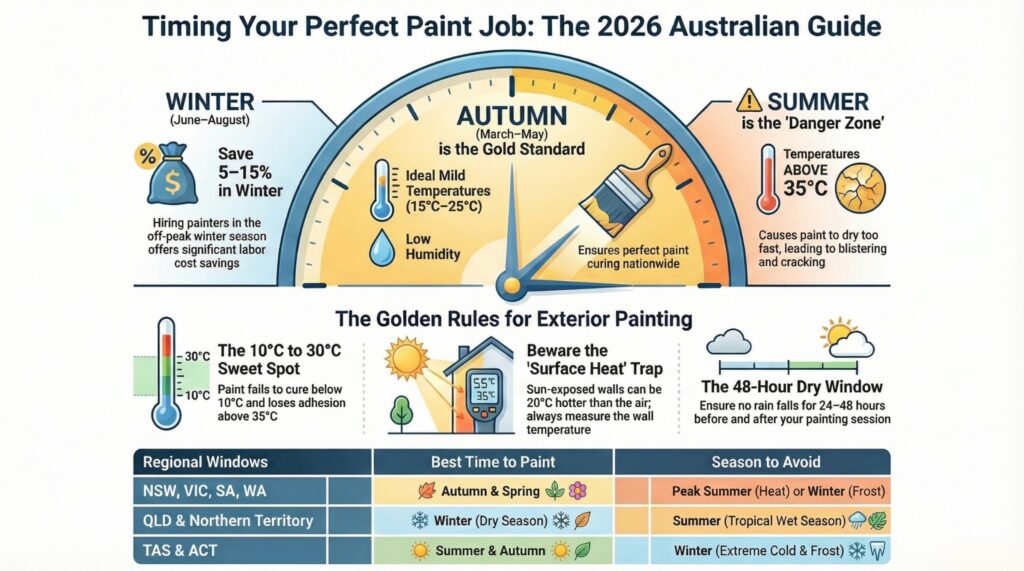
🍂 Autumn (March to May) – Best Overall Season
Autumn is widely considered the best time of year to paint a house in Australia by professional painters across the country. The weather is mild, humidity drops after summer, and there is plenty of daylight to work in. Both interior and exterior painting conditions are ideal.
- Temperatures typically sit between 15°C and 25°C – perfect for paint curing
- Humidity is lower than summer, reducing the risk of mould and slow drying
- Stable, consistent weather with fewer sudden storms
- Great time to repair summer weather damage and repaint in one go
| ✅ Autumn Verdict: The best season for both exterior and interior painting across most of Australia. Book early – autumn slots fill up fast, especially with quality painters. |
🌸 Spring (September to November) – Second Best
Spring is an excellent time to paint, with warm temperatures and long daylight hours. It is particularly good for exterior painting because paint dries at a steady, even pace. The main thing to watch for is spring rainfall – sudden showers can delay exterior jobs.
- Temperatures between 15°C and 28°C – good for most paint types
- Longer days give more working time for exterior crews
- Watch for spring storms in October and November in south-east Australia
- Painters book up faster in spring than any other season – plan 6 to 8 weeks ahead
| ✅ Spring Verdict: An excellent choice, particularly for exterior painting. Keep an eye on the forecast and be ready to reschedule around rain. |
❄️ Winter (June to August) – Best for Saving Money
Winter is often overlooked for painting, but in most parts of Australia – except for Tasmania and inland VIC/NSW – winters are mild and dry enough for painting. The big advantage of winter is cost. Painters are less busy, which means better availability and sometimes lower prices.
- Temperature in most states stays above 10°C – acceptable for Colorbond-style and acrylic paints
- Low humidity in most regions helps paint dry evenly
- You can often save 5 to 15 percent on labour costs compared to peak season
- Avoid winter painting in Victoria’s alpine areas, inland NSW, and Tasmania where frosts are common
| ⚠ Winter Verdict: A smart choice for budget-conscious homeowners in most Australian states. Avoid if you live in a frost-prone area or if your painter will be working in temperatures below 10°C. For interior painting, winter is perfectly fine everywhere. |
☀️ Summer (December to February) – Proceed with Caution
Summer is the busiest and most expensive time to hire a painter in Australia. It is also the most problematic for exterior painting, particularly in Queensland, the Northern Territory, and Western Australia, where heat and storms can wreak havoc on a fresh coat of paint.
- Extreme heat (35°C to 45°C) causes paint to dry too fast, creating blistering and cracking
- High humidity in northern states traps moisture under paint – leading to bubbling and mould
- Storm season in QLD and NT makes exterior scheduling unpredictable
- Peak demand means you will pay more and wait longer for a good painter
- For interior painting in a climate-controlled environment, summer is perfectly fine
| ❌ Summer Verdict: Not recommended for exterior painting, especially in northern Australia. Acceptable for interior painting if you have air conditioning and good ventilation. In southern states like VIC and SA, early summer (December) can work if you paint in cooler morning hours. |
Interior vs Exterior Painting – Different Timing Rules
Interior and exterior painting have different timing requirements. Here is a simple comparison:
| Factor | Interior Painting | Exterior Painting |
| Best season | Autumn or Spring – but flexible year-round | Autumn or Spring – strict requirement |
| Temperature | 10°C to 35°C – interior is climate-controlled | 10°C to 30°C – must match outside temp |
| Humidity | Keep room ventilated – open windows | Below 85% – check daily forecast |
| Rain | No impact (you are inside) | No rain within 24–48 hours before and after |
| Winter OK? | ✅ Yes, in all states with good ventilation | ⚠ Possible in most states, avoid in frost areas |
| Summer OK? | ✅ Yes, with air conditioning and ventilation | ❌ Risky — avoid above 35°C and in QLD/N– |
For more painting advice and tips, visit our painting category for Australian homeowner guides.
Ideal Temperature and Humidity for House Painting in Australia
Before you (or your painter) starts any job, these are the numbers to know:
| Condition | Ideal Range | What Happens Outside This Range |
| Air temperature | 10°C to 30°C | Below 10°C – paint will not cure. Above 35°C – blistering and cracking. |
| Surface temperature | 10°C to 35°C (wall surface) | Hot surfaces in direct sun can be 15–20°C hotter than air – always measure the wall, not just the air. |
| Humidity | 40% to 70% | Above 85% – paint fails to bond, mould risk. Below 30% – paint dries too fast, rough finish. |
| Wind speed | Calm to light breeze | Strong wind blows dust and debris into wet paint, leaves rough surface. |
| Rain forecast | No rain 24–48 hrs before and after | Even a short shower on wet exterior paint can ruin the entire job. |
| 💡 Pro Tip: Always check the surface temperature of your wall – not just the air temperature – before painting outside. A west-facing brick wall in afternoon sun can easily reach 50°C even when the air temperature is only 28°C. Paint applied to a hot surface will blister and peel. According to Haymes Paint, one of Australia’s leading paint brands, humidity above 85% prevents most paints from curing correctly. |
State-by-State Guide – Best Time to Paint Your House in Australia
Australia’s climate varies enormously across states and territories. What works in Melbourne can be completely wrong for Darwin or Perth. Here is the definitive state-by-state guide:
| State / Territory | Best Time to Paint (Exterior) | Season to Avoid | Key Reason |
| Sydney / NSW | Autumn (Mar–May) or Spring (Sep–Nov) | Peak summer Dec–Feb | Mild and dry in autumn; spring storms can delay jobs |
| Melbourne / VIC | Autumn (Mar–Apr) or early Spring (Sep–Oct) | Winter (wet, frosts in alpine areas) | Autumn is the sweet spot before Melbourne’s unpredictable winter |
| Brisbane / QLD | Winter (Jun–Aug) | Nov–Apr (wet season + storms) | Dry mild winters are ideal; summer is too wet and stormy |
| Perth / WA | Spring (Sep–Nov) or Autumn (Mar–Apr) | Winter (wettest months in Perth) | Perth winters are surprisingly rainy; spring and autumn are best |
| Adelaide / SA | Autumn (Mar–May) or Spring | Peak summer (extreme heat 40°C+) | SA’s extreme summer heat is the main enemy of exterior paint |
| Darwin / NT | Dry season only (May–Sep) | Oct–Apr (wet season) | Darwin’s wet season brings 1,500mm+ of rain – painting is impossible |
| Cairns / Far North QLD | Dry season (Apr–Sep) | Nov–Mar (tropical wet season) | Cyclone risk and heavy rainfall rule out the wet season entirely |
| Hobart / TAS | Summer (Jan–Feb) | Winter (coldest + wettest in Australia) | Tasmania’s mild summer is the only reliable dry painting window |
| Canberra / ACT | Autumn (Mar–May) | Winter (regular frosts) | Canberra’s frosts affect paint curing – avoid July and August |
| ⚠ Northern Australia Note: If you live in Darwin, Cairns, or anywhere in tropical north Queensland, your window for exterior painting is limited to the dry season – roughly May to September. Every quality painter in these regions books up months in advance during this period. Start planning in February or March. |
What to Avoid – Worst Conditions for House Painting
Just as important as knowing the best time is knowing when not to paint. Here are the conditions to avoid at all costs:
- Painting in direct hot sun above 35°C – causes paint to dry too fast and blister
- Painting when rain is forecast within 24 hours – even a light shower can strip fresh exterior paint
- Painting in strong wind – blows dust and debris into wet paint, leaves a rough, gritty surface
- Painting on a damp or wet surface – paint will not stick, guaranteed to peel
- Painting when temperatures drop below 10°C at night – even if daytime is warm, overnight cold ruins the curing process
- Painting in foggy or dewy conditions – moisture on the surface prevents adhesion
| ⚠ Common Mistake: Many homeowners check the daytime temperature and think conditions are fine – but forget to check what happens overnight. If the temperature drops below 10°C during the night after painting, water-based paint will not cure properly and can start peeling within weeks. Always check the overnight forecast as well. |
Is Winter Painting Worth It? Cost Savings Explained
One of the best-kept secrets in the painting industry is that winter is the cheapest time to hire a painter in most Australian states. Here is why:
- Demand drops significantly in June and July – painters have more open slots
- Many painting contractors offer quiet-season pricing to keep their teams busy
- You can often save 5 to 15 percent on labour costs compared to peak spring and autumn
- You will get better pick of the best painters – rather than whoever is left with availability
| Season | Average Painter Availability | Relative Cost | Best For |
| Summer (Dec–Feb) | Very low – booked out | Highest | Interior only (climate-controlled) |
| Autumn (Mar–May) | Low–Medium – books up fast | High | Exterior and interior – best quality |
| Winter (Jun–Aug) | High – good availability | Lowest (5–15% cheaper) | Interior and mild-climate exterior |
| Spring (Sep–Nov) | Low – second busiest season | Medium–High | Exterior and interior – watch for rain |
Just like our guide on the best time to replace your roof in Australia – timing your painting project in the off-peak season can put real money back in your pocket without sacrificing quality.
Practical Tips for Timing Your Paint Job
Here are simple, actionable tips to help you plan your painting project for the best possible result:
- Book 4 to 8 weeks ahead for autumn and spring – these seasons fill up fast with quality painters
- Check the 5 to 7 day weather forecast before starting any exterior job – do not rely on a single day’s forecast
- Ask your painter what temperature and humidity they work within – a good painter will have clear guidelines
- Schedule exterior work for mid-morning to early afternoon (10am to 3pm) – morning dew has cleared and there is enough time for paint to dry before nightfall
- If painting in summer, start on the shaded side of the house and rotate with the shade line as the day progresses
- For interior painting, time it around good ventilation – open windows in mild weather to speed up drying and clear fumes
- If you are painting before selling your home, allow at least 3 to 4 weeks after painting before listing – this gives time for any touch-ups and for paint smell to fully clear
Painting is just one part of improving your home’s value. Read our full guide on home renovation ideas for Australian homeowners for more ways to add value before selling or simply improve your living space.
For expert guidance on paint quality and product specifications suited to Australian conditions, the Australian Painting and Decorating Standards (AS/NZS 2311:2017) is the national benchmark that licensed painters are expected to follow.
Frequently Asked Questions
Here are the most common questions Australian homeowners ask about the best time to paint their house.
Final Thoughts
The best time of year to paint your house in Australia in 2026 is autumn – specifically March to May for most states. You get mild temperatures, stable weather, lower humidity, and the chance to repair summer damage before winter arrives. Spring is a strong second choice for exterior work, and winter is the smartest option if saving money is your priority.
Whatever season you choose, the most important things are simple – check the temperature and forecast before you start, hire a licensed painter, and never rush a job just to beat the weather. A well-timed, well-prepared paint job will protect and beautify your home for 10 to 15 years.
If you found this guide useful, explore more expert home improvement advice on Home Improvement Australia – including guides on roofing, bathroom renovations, kitchen renovations, and choosing the right home builder in Australia.