
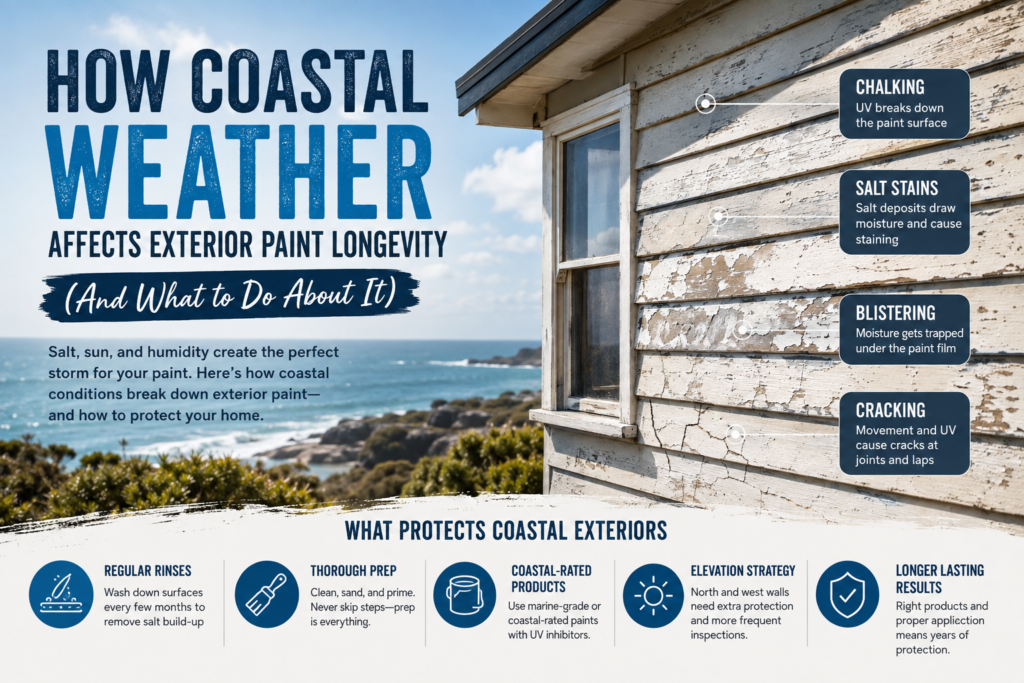
If you live within a few kilometres of the Australian coast, your exterior paint job is working a lot harder than a paint job in an inland suburb. Salt-laden air, relentless UV exposure, and constant humidity swings all attack a painted surface in ways that most homeowners never see coming until the paint starts failing years ahead of schedule.
Understanding why coastal conditions are so much tougher on paint can save you thousands in premature repaints, and it can also help you have a smarter conversation with whichever painter you eventually hire.
Why Coastal Homes Age Paint Faster Than Inland Homes
A standard exterior paint job in a sheltered, inland suburb might comfortably last 8–10 years. Move that same house to a coastal position — Torquay, Barwon Heads, Ocean Grove, or anywhere along the Great Ocean Road corridor, for example — and that lifespan can drop to 4–6 years if the surface wasn’t prepared and coated correctly in the first place.
Three forces are doing most of the damage:
1. Salt Air and Airborne Salt Deposits
Ocean spray carries fine salt particles that settle on exterior surfaces, sometimes kilometres inland depending on wind direction and topography. Salt is hygroscopic, meaning it draws moisture out of the air and holds it against the painted surface. Over time this creates a cycle of wetting and drying that breaks down the paint film, particularly around joints, laps, and fixings where salt tends to accumulate.
Left unwashed, salt deposits also interfere with adhesion on future coats, which is why coastal properties benefit from a fresh-water rinse of exterior surfaces every few months, not just before a repaint.
2. UV Intensity
Australia’s UV levels are among the highest in the world, and coastal positions often have fewer natural windbreaks — established trees, hills, or neighbouring buildings — to filter direct sun exposure. UV breaks down the resin binders in paint, leading to chalking (a powdery surface residue), fading, and eventually cracking as the film becomes brittle.
North and west-facing elevations cop the worst of it and will often show visible wear years before the more sheltered sides of the same house.
3. Humidity and Temperature Swings
Coastal microclimates tend to swing between damp, salty mornings and hot, dry afternoons. That daily expansion and contraction stresses the paint film, especially on timber substrates like weatherboard, which move with moisture far more than brick, render, or fibre cement.
The Failure Signs Coastal Homeowners Should Watch For
- Chalking — a fine, powdery residue that rubs off on your hand when you touch the wall. This is a sign the paint’s UV protection is exhausted.
- Blistering — small bubbles in the paint film, usually caused by trapped moisture pushing through from behind, common in areas that don’t drain or dry properly.
- Salt staining and efflorescence — white, crusty deposits, particularly around render and masonry joints.
- Early colour fade — most noticeable on darker colours, which absorb more UV energy and degrade faster in high-exposure coastal positions.
- Cracking at joints and laps — where movement is greatest and coating film is thinnest.
If you’re seeing any of these within five years of a repaint, it’s usually a preparation or product issue rather than simple bad luck.
What Actually Protects Coastal Exteriors
Surface preparation matters more here than anywhere else. A rushed prep job that might get away with it in a sheltered inland suburb will fail fast on the coast. That means a genuine wash-down to remove salt and contaminants, thorough sanding of any chalked or failing paint, and priming bare timber or problem areas before topcoats go on — not skipping straight to colour.
Product selection is not optional. Marine-grade or coastal-rated exterior acrylics, formulated with higher UV inhibitors and better flexibility, cost more per litre but routinely outlast standard exterior paint by several years in these conditions. On timber, a quality oil-based or acrylic primer sealer designed for exterior movement is worth the extra step.
Elevation-specific coating strategy. It’s reasonable to treat north and west-facing walls differently to the more sheltered south and east sides — extra coats, better-grade product, or simply more frequent inspection on the elevations taking the most punishment.
Regular maintenance rinses. A garden-hose rinse of exterior walls every few months removes salt build-up before it has a chance to compromise the paint film, extending the interval between full repaints.
Working With a Painter Who Understands Coastal Conditions
Not every painting quote accounts for the extra prep, primer, and product upgrades that coastal work genuinely needs — which is often why some quotes look cheaper on paper but end up costing more in early repaints. It’s worth asking any painter directly how they’d prepare and coat a coastal-facing wall differently to an inland one; a specific, confident answer is usually a good sign.
Painters working across coastal and inland suburbs alike see this contrast constantly. For instance, painters in Highton are dealing with a more sheltered, inland microclimate, while a crew handling the same brief closer to the Bellarine or Surf Coast is factoring in salt exposure and UV load from the outset. Similarly, Newtown painters working on established weatherboard homes further from the coast can often get more mileage from a standard exterior system than a property exposed to direct sea air.
The Bottom Line
Coastal paint failure is rarely just bad luck – it’s almost always a combination of under-specified product, rushed prep, or a coating system that wasn’t chosen with salt, UV, and humidity in mind. Spending a little more upfront on the right preparation and coastal-rated product will consistently outperform a cheaper job that needs redoing in half the time.
If you’re planning an exterior repaint on a coastal or near-coastal property, it’s worth getting a quote that specifically addresses these conditions — not a generic price based on square metreage alone.