Replacing a roof is one of the biggest expenses a homeowner will face. If you are trying to keep costs down, choosing the right roofing material is one of the best decisions you can make – it can save you thousands of dollars upfront and for years to come.
But here is the thing – the cheapest material to buy is not always the cheapest material over time. Some low-cost options wear out in 15 years. Others cost a little more upfront but last 50 years and barely need any maintenance.
In this guide, we break down every affordable roofing material available in Australia in 2026 – what they cost per square metre, how long they last, and which ones give you the best value for your money.
Cheapest Roofing Materials in Australia – Quick Price Comparison
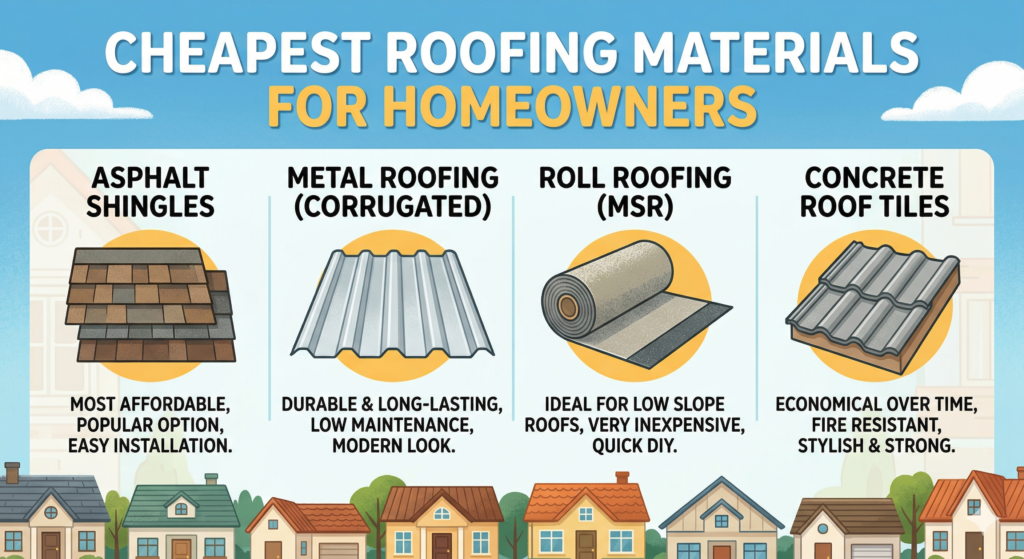
Here is a quick snapshot of the most common roofing materials and their approximate cost per square metre installed in Australia in 2026. Full breakdowns are in the sections below.
| Material | Cost per m² (Installed) | Lifespan | Best For |
| Corrugated Iron / Metal | $40 – $70 per m² | 40–70 years | Budget builds, rural, sheds |
| Concrete Roof Tiles | $50 – $80 per m² | 30–50 years | Most Australian homes |
| Zincalume Steel | $45 – $75 per m² | 40–60 years | Coastal & rural properties |
| Colorbond Steel | $60 – $100 per m² | 40–70 years | Modern homes, best value long-term |
| Asphalt Shingles | $60 – $90 per m² | 15–30 years | Lower upfront cost (limited AU use) |
| Terracotta Tiles | $90 – $130 per m² | 50–80 years | Premium homes, heritage style |
| Polycarbonate Sheets | $30 – $60 per m² | 10–20 years | Carports, pergolas, patios |
| 💡 Quick Answer The cheapest roofing material in Australia per square metre is corrugated iron or Zincalume steel, starting from around $40 per m² installed. However, for the best long-term value – low maintenance plus durability – Colorbond steel is considered the smartest budget choice by most Australian roofers. |
Affordable Roofing Materials – Full Breakdown
Let’s go through each material in detail so you can make an informed decision based on your home, your location, and your budget.
1. Corrugated Iron / Corrugated Metal Roofing
Corrugated iron is the most budget-friendly roofing option in Australia. It has been used on Australian homes and sheds for over 150 years, and for good reason – it is tough, lightweight, easy to install, and genuinely cheap.
| Detail | Information |
| Cost per m² (supply only) | $15 – $30 per m² |
| Cost per m² (installed) | $40 – $70 per m² |
| Average cost – full roof (150m²) | $6,000 – $10,500 |
| Lifespan | 40 to 70 years with basic maintenance |
| Maintenance level | Low – occasional cleaning and paint touch-ups |
| Best for | Rural properties, sheds, budget new builds, extensions |
The downside of plain corrugated iron is that it can rust over time, especially in coastal or tropical areas. If that is a concern for your location, look at Zincalume or Colorbond instead – both are coated versions that resist corrosion much better.
| ✅ Pro Tip If you are in a rural or regional area of Australia, corrugated iron is often the most practical and affordable choice. Contractors in country areas are very familiar with it, which keeps labour costs lower too. |
2. Concrete Roof Tiles
Concrete tiles are one of the most common roofing materials on Australian suburban homes. They look great, handle Australian weather well, and sit right in the middle of the price range — not the cheapest, but far from the most expensive.
| Detail | Information |
| Cost per m² (supply only) | $20 – $40 per m² |
| Cost per m² (installed) | $50 – $80 per m² |
| Average cost – full roof (150m²) | $7,500 – $12,000 |
| Lifespan | 30 to 50 years |
| Maintenance level | Low-medium – repointing every 10–15 years |
| Best for | Suburban homes across Sydney, Melbourne, Adelaide, Perth |
The main thing to be aware of with concrete tiles is that they are heavy. Older homes may need structural reinforcement before you can install them, which adds cost. Also, damaged tiles can be harder to colour-match if the product line has been discontinued.
3. Zincalume Steel
Zincalume is a steel roofing product coated with a zinc and aluminium alloy that protects against rust. Think of it as an upgraded version of plain corrugated iron – it looks similar but handles corrosion significantly better and lasts longer.
| Detail | Information |
| Cost per m² (supply only) | $18 – $35 per m² |
| Cost per m² (installed) | $45 – $75 per m² |
| Average cost – full roof (150m²) | $6,750 – $11,250 |
| Lifespan | 40 to 60 years |
| Maintenance level | Low – occasional inspection and clean |
| Best for | Coastal areas, rural properties, budget-conscious homeowners |
Zincalume is a great mid-point option – cheaper than Colorbond but significantly more durable than uncoated corrugated iron. If you want metal roofing but do not need the colour options of Colorbond, Zincalume is a solid choice.
4. Colorbond Steel – Best Long-Term Value
Colorbond is Australia’s most popular roofing material, and for good reason. It is made from high-strength steel with a durable painted finish, available in 22 colours, and is designed specifically for Australian conditions – heat, UV, rain, and coastal salt.
| Detail | Information |
| Cost per m² (supply only) | $25 – $50 per m² |
| Cost per m² (installed) | $60 – $100 per m² |
| Average cost – full roof (150m²) | $9,000 – $15,000 |
| Lifespan | 40 to 70 years with minimal maintenance |
| Maintenance level | Very low – just wash it occasionally |
| Best for | Modern homes, all climates, best overall value |
Yes, Colorbond costs more upfront than corrugated iron or concrete tiles. But when you factor in its lifespan, near-zero maintenance costs, and the fact that it comes with a manufacturer warranty of 25 to 36 years, it often works out cheaper over the lifetime of your roof.
| 💡 Good to Know Colorbond Ultra is the version designed for severe marine environments (within 100m of the ocean). If you live near the coast, always specify Colorbond Ultra – it costs slightly more but is specifically rated for high-salt-air conditions. |
5. Asphalt Shingles
Asphalt shingles are the most common roofing material in the United States, but they are not as widely used in Australia. You can find them here, and they are relatively affordable – but there are some important things to know before choosing them.
| Detail | Information |
| Cost per m² (supply only) | $20 – $40 per m² |
| Cost per m² (installed) | $60 – $90 per m² |
| Average cost – full roof (150m²) | $9,000 – $13,500 |
| Lifespan | 15 to 30 years (shorter in hot Australian climates) |
| Maintenance level | Medium – can crack in extreme heat |
| Best for | Mild climate areas, those wanting a US-style look |
The main drawback of asphalt shingles in Australia is that they are not well suited to extreme heat. In states like Queensland, Western Australia, and South Australia, the intense UV and high temperatures can cause them to crack and degrade faster than their stated lifespan. In cooler states like Victoria and Tasmania, they perform better.
| ⚠ Worth Knowing Because asphalt shingles are not as common in Australia, finding contractors experienced in installing them can be harder. Fewer local suppliers also means higher material costs compared to countries where they are the standard choice. |
6. Polycarbonate Roofing Sheets
Polycarbonate sheets are a lightweight, translucent roofing material most commonly used for carports, pergolas, patios, and verandahs rather than full home roofs. If you are covering an outdoor area on a tight budget, they are the cheapest option available.
| Detail | Information |
| Cost per m² (supply only) | $10 – $25 per m² |
| Cost per m² (installed) | $30 – $60 per m² |
| Lifespan | 10 to 20 years |
| Maintenance level | Low – but yellows over time with UV exposure |
| Best for | Carports, pergolas, patios, temporary structures |
Polycarbonate is not suitable as the primary roofing material for a full home – it does not provide adequate insulation or weather protection for a living space. But for covered outdoor areas, it is hard to beat on price.
| [ 📊 INFOGRAPHIC – Insert material comparison infographic here (cost per m² vs lifespan chart) ] |
Cheapest Roofing Material by Australian State and Climate
This is something no other guide covers properly – the cheapest material for your home depends a lot on where you live in Australia. What works perfectly in Melbourne can fall apart quickly in Darwin. Here is a state-by-state guide.
| State / Region | Best Budget Material | Why | Avoid |
| Sydney / NSW | Concrete tiles or Colorbond | Handles coastal humidity and moderate temps well | Plain corrugated iron near coast |
| Melbourne / VIC | Concrete tiles or Colorbond | Handles VIC’s cold winters and wind well | Asphalt shingles (poor in cold wet winters) |
| Brisbane / QLD | Colorbond or Zincalume | Cyclone-rated options, handles heat and storms | Asphalt shingles (crack in QLD heat) |
| Perth / WA | Colorbond | Handles extreme heat + coastal salt air well | Plain corrugated iron near the coast |
| Adelaide / SA | Concrete tiles or Colorbond | Handles extreme SA heat well with BAL-rated options | Asphalt shingles |
| Darwin / NT | Colorbond or Zincalume (cyclone rated) | Only cyclone-rated metal roofing is suitable in NT | Tiles (cyclone risk), polycarbonate |
| Hobart / TAS | Concrete tiles or Colorbond | Handles TAS cold and rain without the UV concerns | Zincalume (can corrode faster in TAS rain) |
| Coastal anywhere | Colorbond Ultra | Specifically rated for high salt-air coastal zones | Uncoated corrugated iron |
| ✅ Pro Tip If you live in a Bushfire Attack Level (BAL) zone – common across rural Australia – your roofing material choice may be governed by Australian Standards AS 3959. Always check your BAL rating before selecting a material. Colorbond and concrete tiles both have BAL-rated product options. |
Upfront Cost vs Long-Term Value – What Is Actually the Cheapest?
This is the most important thing to understand before you choose a material. The cheapest roof to buy today is not always the cheapest roof over 20 or 30 years.
Here is a simple comparison of total cost over 40 years for a 150m² home, including installation, maintenance, and likely replacement:
| Material | Install Cost (150m²) | Maint. over 40 yrs | Replacement needed? | Total 40-yr Cost |
| Corrugated Iron | $6,000 – $10,500 | ~$1,500 | Possibly (at 40 yrs) | $7,500 – $14,000 |
| Concrete Tiles | $7,500 – $12,000 | ~$2,500 | No (if maintained) | $10,000 – $14,500 |
| Zincalume | $6,750 – $11,250 | ~$1,200 | Unlikely | $7,950 – $12,450 |
| Colorbond | $9,000 – $15,000 | ~$500 | No | $9,500 – $15,500 |
| Asphalt Shingles | $9,000 – $13,500 | ~$2,000 | Yes (at 20–25 yrs) | $18,000 – $30,000 |
| Terracotta Tiles | $13,500 – $19,500 | ~$2,000 | No | $15,500 – $21,500 |
As you can see, asphalt shingles look affordable upfront but can end up being the most expensive option over time because they often need replacing within 20 to 25 years in Australian conditions. Colorbond costs more to install but its near-zero maintenance and 40 to 70 year lifespan make it one of the most cost-effective choices long-term.
| 💡 Key Takeaway If you are building or re-roofing and plan to stay in your home for 10+ years – Colorbond or Zincalume will save you more money over time than almost any other option. If you need the absolute lowest upfront cost and are happy to budget for maintenance, corrugated iron or concrete tiles are solid choices. |
What Else Affects the Cost of Roofing Materials?
The material itself is just one part of the total roofing cost. Here are the other factors that will affect your final bill:
- Roof size and pitch – Larger roofs cost more in materials and labour. Steeper pitches are harder to work on and push up labour costs.
- Labour costs – A licensed roofer in Sydney or Melbourne charges more per hour than one in a regional area. Labour typically makes up 40 to 60 percent of total roofing cost.
- Roof complexity – Hips, valleys, skylights, and chimneys all add time and material wastage, which increases cost.
- Removal of old roofing – Stripping and disposing of your old roof adds $1,000 to $4,000 to most jobs.
- Sarking and insulation – If your roofer recommends sarking (a foil membrane under the roof), add $1,500 to $4,000 to the total.
- Scaffold hire – Required for most two-storey homes. Adds $500 to $2,500 depending on access.
- Location – Material delivery costs are higher in remote and regional areas.
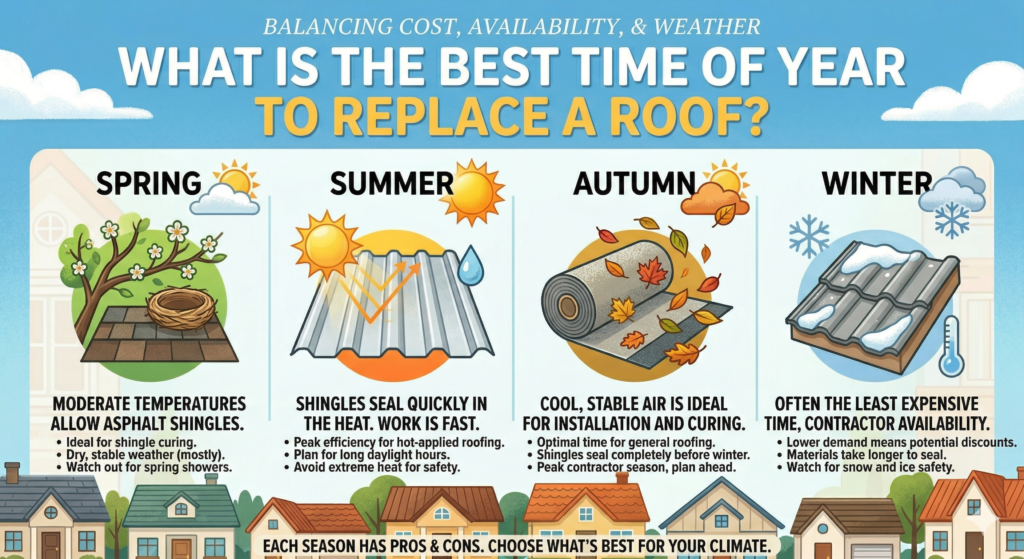
- Time of year – Booking in winter (June to July) can save you 5 to 15 percent compared to peak season. Read our guide on the best time to replace your roof in Australia for more detail.
DIY vs Professional Installation – Which Saves More Money?
Roofing is one of the trades where DIY rarely makes financial sense for a full roof replacement. Here is why:
| Factor | DIY | Professional |
| Material cost | Same as pro (no trade discount) | Access to trade pricing – often 10–20% cheaper |
| Labour cost | Free (your time) | $60–$120 per hour |
| Quality risk | High – errors can cause leaks | Low – licensed tradespeople are accountable |
| Safety risk | Very high – falls are the #1 cause of serious injury in DIY | Managed by trained professionals with safety gear |
| Insurance | Not covered under home insurance if DIY causes damage | Fully covered – licensed contractors carry public liability |
| Warranty | None | Workmanship warranty typically 5–10 years |
In most Australian states, full roof replacement must legally be carried out by a licensed builder or roofing contractor. Attempting to DIY a full re-roof can void your home insurance and create costly problems when you try to sell the property.
Where DIY can legitimately save you money is in small maintenance jobs — replacing a single broken tile, cleaning gutters, or applying roof sealant. For anything structural or involving more than a few tiles, always hire a licensed professional.
| ⚠ Important: Always ask for your roofer’s licence number and verify it with your state building authority before signing any contract. In NSW check Service NSW, in VIC check the Victorian Building Authority, and in QLD check the QBCC. This protects you legally and financially. |
How to Save Money on Roofing Without Cutting Corners
Here are practical, proven ways to reduce your roofing cost without sacrificing quality:
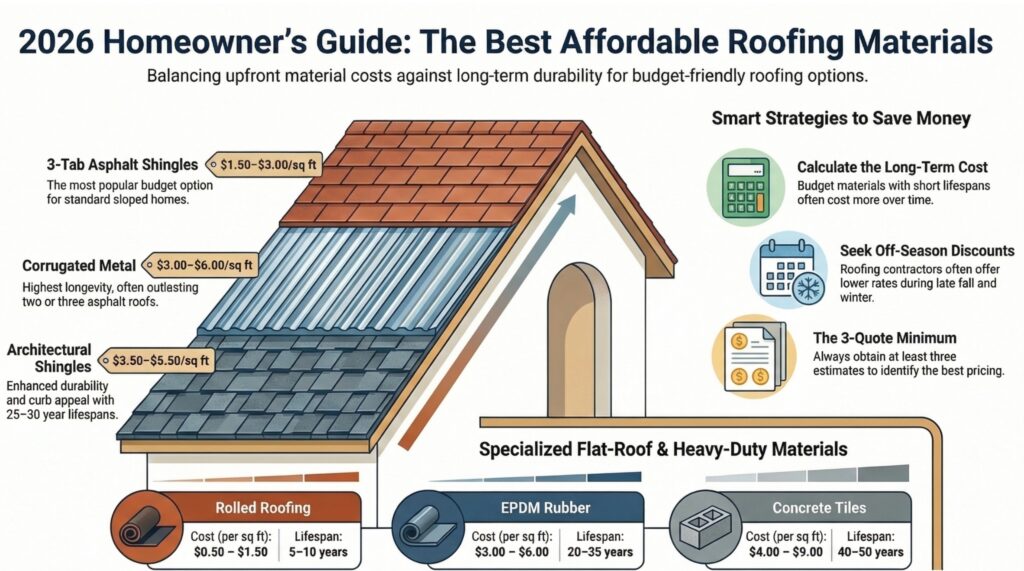
- Get at least three quotes – Prices can vary by 20 to 30 percent between roofers for the same job. Never accept the first quote.
- Book in winter – June and July are the quietest months for roofers. Many offer better rates to fill their schedule.
- Ask about surplus stock – Some roofers carry leftover Colorbond or tile stock from previous jobs. If the colour works for you, it can reduce material costs.
- Bundle with gutter replacement – If your gutters need replacing anyway, doing it at the same time saves on call-out and scaffolding costs.
- Choose a lighter colour Colorbond – Lighter Colorbond colours reflect more heat, which can reduce your cooling costs in summer by up to 10 to 15 percent.
- Check your home insurance – If damage was caused by a storm or hail event, your insurer may cover part or all of the replacement cost.
- Ask about government rebates – Some states offer energy efficiency rebates for roofing upgrades. Check your state government’s energy website for current offers.
- Choose a material with long warranty – A material with a 25-year manufacturer warranty reduces your long-term risk and gives you negotiating power on price.
Frequently Asked Questions
Here are the most common questions Australian homeowners ask about affordable roofing materials.
Final Thoughts
The cheapest roofing material in Australia in 2026 depends on what you mean by cheap. If you need the lowest possible upfront cost, corrugated iron or Zincalume steel starting from around $40 per square metre is your answer. If you want the lowest total cost over the life of your home, Colorbond steel is almost always the smarter investment.
Whatever you choose, get at least three quotes from licensed roofers, make sure your material suits your local climate and any bushfire or coastal requirements, and never rush the decision. A roof replacement is a once-in-a-generation investment – getting it right is worth taking the time.
If you found this guide helpful, browse more expert roofing articles and home improvement guides on Home Improvement Australia.