A plumbing problem always seems to happen at the worst possible time – a burst pipe on a Sunday night, a blocked drain right before guests arrive, or a hot water system that packs it in on a cold winter morning.
Before you pick up the phone, it helps to know what you are likely to pay. Plumbing costs in Australia can vary quite a bit depending on the job, the time of day, and where you live. This guide breaks it all down in plain English – hourly rates, call-out fees, typical job costs, and how to make sure you are not overpaying.
Planning a bathroom or kitchen renovation that includes plumbing work? Read our bathroom renovation guide and kitchen renovation guide for full cost breakdowns across every trade.
Plumber Cost in Australia – Quick Price Snapshot (2026)
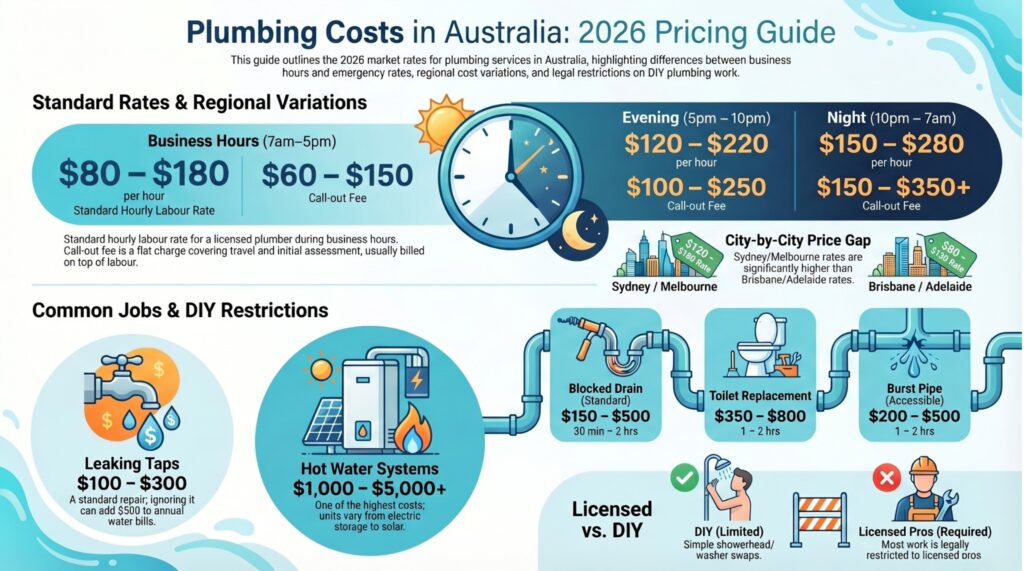
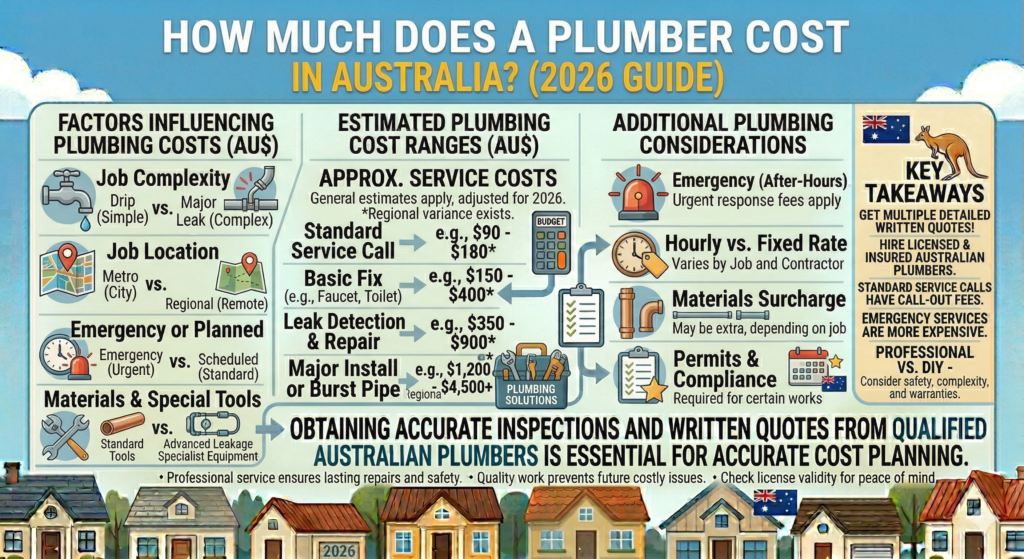
Here is what most Australian homeowners pay for common plumbing jobs in 2026, including call-out fee and labour:
| Job Type | Typical Cost (AUD) | Time to Complete |
| Standard hourly rate (business hours) | $80 – $180 per hour | Charged per job |
| Call-out fee (business hours) | $60 – $150 | On top of labour |
| After-hours / emergency call-out | $150 – $400+ | On top of labour |
| Leaking tap repair | $100 – $300 | 30 min – 1.5 hrs |
| Blocked drain (standard) | $150 – $500 | 30 min – 2 hrs |
| Blocked drain (high-pressure jet) | $300 – $800 | 1 – 3 hrs |
| Toilet replacement | $350 – $800 | 1 – 2 hrs |
| Tap replacement (kitchen or bathroom) | $150 – $400 | 1 – 2 hrs |
| Hot water system replacement | $1,000 – $5,000+ | 2 – 5 hrs |
| Burst pipe repair | $300 – $1,500+ | 1 – 4+ hrs |
| New bathroom rough-in plumbing | $2,500 – $6,000+ | 1 – 3 days |
| CCTV drain inspection | $200 – $500 | 30 min – 1.5 hrs |
| 💡 Quick Answer: Most Australians pay between $80 and $180 per hour for a licensed plumber during business hours, plus a call-out fee of $60 to $150. A typical small job – like fixing a leaking tap or a basic blocked drain – comes to around $150 to $350 all in. Emergency or after-hours work costs significantly more. |
How Do Plumbers Charge in Australia?
Before you get a quote, it helps to understand the two main ways Australian plumbers charge for their work. Knowing this will help you compare quotes properly and avoid bill shock.
1. Hourly Rate + Call-Out Fee
This is the most common pricing model for small and medium jobs. Here is how it works:
- The call-out fee is a flat charge just for the plumber to come to your property. It covers their travel time and the first assessment of the problem. This is usually $60 to $150 during business hours.
- The hourly rate is then charged on top – typically $80 to $180 per hour – for the actual time spent working.
- Materials and parts are charged separately on top of both.
- Most plumbers bill in minimum increments – usually 30 minutes or 1 hour – so even a 15-minute job will be billed as at least 30 minutes.
| ⚠ Always Confirm the Call-Out Fee Upfront: Some plumbers include the call-out fee within the first hour of labour. Others charge it separately. Before anyone arrives at your home, ask clearly: ‘Is the call-out fee included in your hourly rate, or is it charged on top?’ This one question can save you $80 to $150. |
2. Fixed-Price (Flat Rate) Quotes
For straightforward, well-defined jobs – like installing a new toilet, replacing a hot water system, or fitting new taps – many plumbers will offer a fixed-price quote. You agree on the total price before work starts, and that is what you pay regardless of how long it takes.
- Fixed pricing gives you certainty – no surprise bill at the end
- The plumber carries the risk if the job takes longer than expected
- Best for jobs where the scope is clear and unlikely to change once the work starts
- For fault-finding jobs – like a mystery leak or recurring blocked drain – hourly is more common because the plumber does not know what they will find until they start
After-Hours and Emergency Plumber Costs
Plumbing emergencies do not wait for business hours. A burst pipe at 11pm or a blocked toilet on Christmas morning means calling an emergency plumber — and that comes at a premium.
| Time of Call | Call-Out Fee | Hourly Rate | Notes |
| Business hours (Mon–Fri, 7am–5pm) | $60 – $150 | $80 – $180/hr | Standard rates – most affordable |
| Evening (5pm – 10pm weekdays) | $100 – $250 | $120 – $220/hr | After-hours surcharge applies |
| Night (10pm – 7am) | $150 – $350+ | $150 – $280/hr | Night call premium rates |
| Saturday | $100 – $250 | $130 – $250/hr | Weekend rates typically 25–50% higher |
| Sunday / Public holiday | $200 – $400+ | $180 – $350+/hr | Double-time rates common |
The key question when facing an emergency is: can this wait until morning? If water is actively flooding your home, damaging floors or walls, or the problem is a health risk – call an emergency plumber immediately. The cost of water damage can far exceed the after-hours surcharge. But if you can safely turn off the water at the mains and contain the problem, waiting until business hours can save you hundreds of dollars.
Not sure where your water mains shutoff is or what to do in a plumbing emergency? The Australian Government’s water efficiency resources has guidance for Australian homeowners on managing water emergencies at home.
Plumber Cost by City in Australia (2026)
Labour rates vary across Australia. Here is a realistic guide to what you can expect to pay in major Australian cities for standard business-hours plumbing work:
| City / Region | Hourly Rate (Business Hours) | Call-Out Fee | Notes |
| Sydney / NSW | $120 – $180/hr | $80 – $150 | Highest labour costs in Australia – inner city adds more |
| Melbourne / VIC | $100 – $180/hr | $80 – $150 | Wide range – outer suburbs cheaper than inner city |
| Brisbane / QLD | $80 – $130/hr | $60 – $120 | Generally more affordable than Sydney and Melbourne |
| Perth / WA | $90 – $150/hr | $70 – $130 | Mid-range – remote and coastal areas attract travel fees |
| Adelaide / SA | $80 – $130/hr | $60 – $110 | Among the most affordable major cities |
| Canberra / ACT | $100 – $160/hr | $80 – $140 | Higher due to government compliance requirements |
| Darwin / NT | $100 – $160/hr | $80 – $150 | Tropical conditions add complexity to many jobs |
| Hobart / TAS | $80 – $130/hr | $60 – $110 | Similar to Adelaide – regional areas vary more |
| Regional / Rural Australia | $70 – $140/hr | $60 – $200+ | Lower hourly rate but higher call-out due to travel |
| 💡 Regional Note: If you live in a rural or remote area, the call-out fee can be significantly higher than city rates because the plumber may have to travel an hour or more to reach you. Some rural plumbers charge a flat travel fee on top of their standard call-out. Always confirm the full travel charge before booking. |
Common Plumbing Jobs – What They Cost in Australia
Here is a more detailed breakdown of what individual plumbing jobs typically cost across Australia in 2026.
Leaking Tap Repair
Fixing a leaking tap is one of the most common plumbing jobs in Australia. The cost depends on whether it is a simple washer replacement or a full tap cartridge and fitting swap.
| Repair Type | Typical Cost |
| Washer replacement (simple tap) | $100 – $200 |
| Ceramic cartridge replacement (mixer tap) | $150 – $300 |
| Full tap replacement (new tap supplied) | $200 – $450 |
| Emergency after-hours leaking tap | $250 – $500+ |
A single leaking tap that drips twice per minute can waste up to 20,000 litres of water per year – adding roughly $500 to your annual water bill. Read our common plumbing problems guide for more on what causes leaking taps and when to repair vs replace.
Blocked Drain
Blocked drains are the second most common call-out for Australian plumbers. The cost varies enormously depending on where the blockage is and what equipment is needed to clear it.
| Drain Job Type | Typical Cost |
| Simple sink or basin blockage (manual clearing) | $100 – $250 |
| Toilet blockage | $150 – $350 |
| High-pressure water jetting (stubborn blockage) | $300 – $700 |
| CCTV drain inspection (to locate the blockage) | $200 – $500 |
| Stormwater or sewer drain clearing | $400 – $1,200+ |
| Tree root removal from drain | $500 – $2,000+ |
Toilet Replacement
Replacing a toilet is a straightforward job for a licensed plumber and usually takes one to two hours. The main cost variable is the toilet unit itself – basic models start around $150, while mid-range units run $300 to $600.
| Toilet Job | Typical Cost |
| Labour only (supply your own toilet) | $200 – $400 |
| Supply + install (basic toilet) | $350 – $600 |
| Supply + install (mid-range toilet) | $500 – $900 |
| Supply + install (premium/wall-hung) | $800 – $2,000+ |
Hot Water System
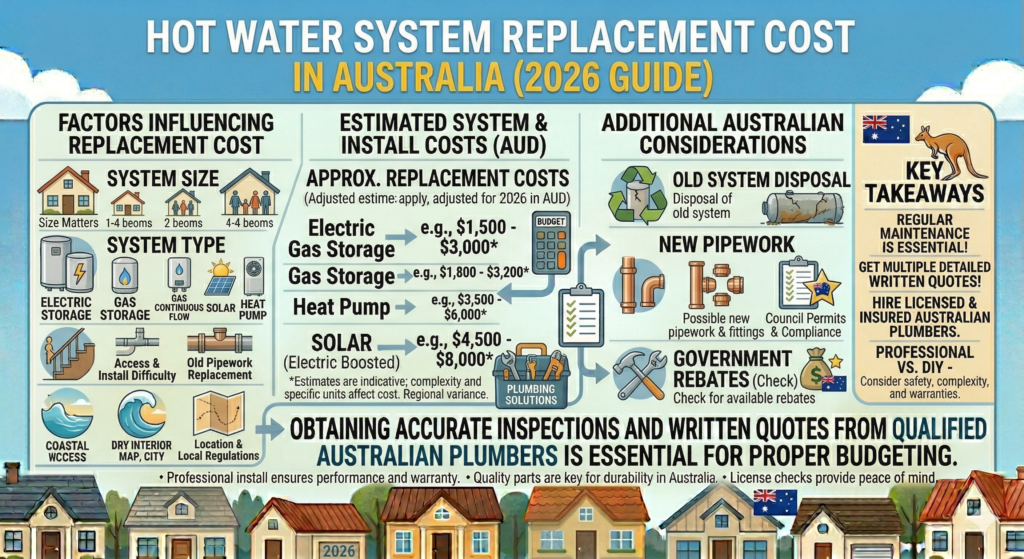
Hot water system replacement is one of the larger plumbing jobs in an Australian home. The cost varies significantly based on the type of system. For a full breakdown of costs by system type, government rebates available, and which system suits your home best, read our dedicated guide.
→ Full guide: Hot Water System Replacement Cost Australia (2026 Guide)
| System Type | Typical Replacement Cost |
| Electric storage (supply + install) | $800 – $2,500 |
| Gas storage (supply + install) | $1,200 – $3,000 |
| Gas continuous flow (supply + install) | $1,500 – $3,000 |
| Heat pump (supply + install, before rebates) | $3,000 – $5,200 |
| Solar (supply + install, before rebates) | $3,000 – $7,000+ |
Burst Pipe
A burst pipe is an emergency that needs immediate attention. The cost depends on where the pipe is – an accessible pipe under a sink costs much less than a pipe buried inside a wall or under a concrete slab.
| Burst Pipe Scenario | Typical Cost |
| Accessible exposed pipe (under sink, in cupboard) | $200 – $500 |
| Pipe inside a wall (requires wall access) | $500 – $1,500+ |
| Underground or slab pipe | $1,500 – $5,000+ |
| Emergency after-hours burst pipe | Add $200 – $500 to above |
What Affects How Much a Plumber Charges?
Two quotes for the same job can come back $300 apart. Here are the main factors that cause price differences:
- Time of day and day of week – Business hours is always cheapest. Evening, weekend, and public holiday work attracts significant surcharges.
- Location – Plumbers in inner-city Sydney or Melbourne charge more than those in suburban or regional areas. Travel distance also affects the call-out fee.
- Complexity and access – A visible, easily accessible problem is quick and cheap to fix. A pipe inside a wall, under concrete, or in a tight roof cavity takes longer and costs more.
- Materials and parts – A basic washer costs $2. A premium ceramic disc cartridge costs $50. High-end tap fittings can run hundreds of dollars. Always ask for an itemised quote.
- Job type – Simple maintenance work (taps, toilets) is straightforward. Fault-finding, pipe relining, or renovation plumbing is more specialised and more expensive.
- Plumber’s experience and licence – A master plumber with 20 years’ experience will charge more than a newly qualified plumber. For complex jobs, the experience is usually worth it.
- Urgency – The less urgent you are, the more negotiating power you have. Non-urgent jobs booked in advance during off-peak periods are generally cheaper.
How to Save Money on Plumbing in Australia
Here are practical, proven tips for getting quality plumbing work done without overpaying:
- Always get at least 3 written quotes – For any job over $500, getting three quotes is worth the time. Prices can vary by 20 to 40 percent for the same work.
- Book during business hours – Avoiding after-hours rates can save you $100 to $300 on a single job. If it is not a true emergency, wait until morning.
- Bundle small jobs into one visit – If you have several small issues (a leaking tap, a slow drain, a dripping showerhead), get them all fixed in one call-out. You pay one call-out fee instead of three.
- Clear the work area before the plumber arrives – Time is money. Remove items from under the sink, move furniture away from access points, and have the relevant information ready (property age, existing pipe type if known).
- Ask for a fixed-price quote on defined jobs – For toilet replacements, tap installations, and hot water systems, ask for a fixed price rather than hourly. It protects you from bill creep.
- Check if your issue is covered by home insurance – Sudden damage from burst pipes or flooding may be covered under your home contents or building insurance policy. Always check before paying out of pocket.
- Ask about rebates for hot water upgrades – If your hot water system needs replacing, federal and state government rebates for heat pumps and solar systems can save $1,000 to $2,500 upfront.
- Verify the licence before booking – Always check your plumber’s licence through your state authority. Unlicensed work may be cheaper upfront but is illegal, not covered by insurance, and may fail building inspections.
To verify a plumber’s licence in your state, visit the Master Plumbers Australia website which lists licensed contractors and associations across all states and territories.
Can I Do Plumbing Work Myself in Australia?
This is one of the most common questions homeowners ask – and the answer is: it depends on what you are trying to do.
In Australia, the plumbing trade is legally regulated. Any work that involves connecting to or disconnecting from the water supply, drainage system, or gas supply must be carried out by a licensed plumber. This is not just best practice – it is the law under the Plumbing Code of Australia.
| Task | DIY Allowed? | Notes |
| Unblocking a sink with a plunger | ✅ Yes | Simple physical clearance – no connection changes |
| Replacing a showerhead (same fittings) | ✅ Yes | If it is a direct like-for-like swap, no connection changes |
| Replacing tap washers (in most states) | ⚠ Check your state | Some states allow it; others require a licensed plumber |
| Installing a new tap or fitting | ❌ No | Involves water supply connection – licensed plumber required |
| Replacing a toilet | ❌ No | Water supply and drainage connection – licensed plumber required |
| Fixing a burst pipe | ❌ No | Regulated water supply work – licensed plumber required |
| Installing a hot water system | ❌ No | Plumbing + electrical/gas – both require licensed trades |
| Gas plumbing of any kind | ❌ No | Gas work requires a licensed gasfitter in all states |
| ⚠ DIY Plumbing Risks: Unlicensed plumbing work can void your home insurance, fail a building inspection when you sell, create water damage, and result in fines. In most Australian states, unlicensed plumbing carries penalties of thousands of dollars. When in doubt – call a licensed plumber. |
Frequently Asked Questions
Here are the most common questions Australians ask about plumber costs.
Final Thoughts
Understanding how plumbers charge in Australia – hourly rates, call-out fees, after-hours surcharges, and fixed-price options – puts you in a much stronger position as a homeowner. You can compare quotes properly, avoid nasty surprises, and make sure you are getting genuine value for money.
The key things to remember are simple: always get at least three written quotes for any significant job, book during business hours where possible, bundle small jobs into one visit, and always verify your plumber’s licence before any work starts.
For more practical home improvement guides for Australian homeowners, explore our plumbing guides, bathroom renovation articles, kitchen renovation guides, and our detailed hot water system replacement cost guide.