A complete Australian guide – by room, by wall material, and by climate zone. Stop guessing and start planning with real timelines and expert tips.
| 5–10 yrs Typical exterior repaint cycle | 3–7 yrs Interior walls average | 2–3 yrs Hallways – most frequent | 4–6 yrs Coastal homes – accelerated |
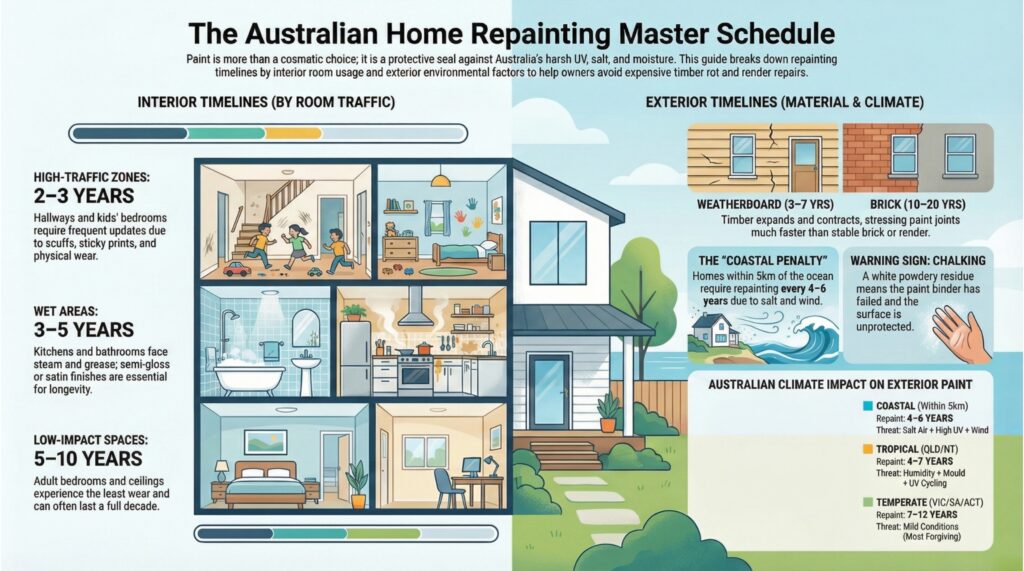
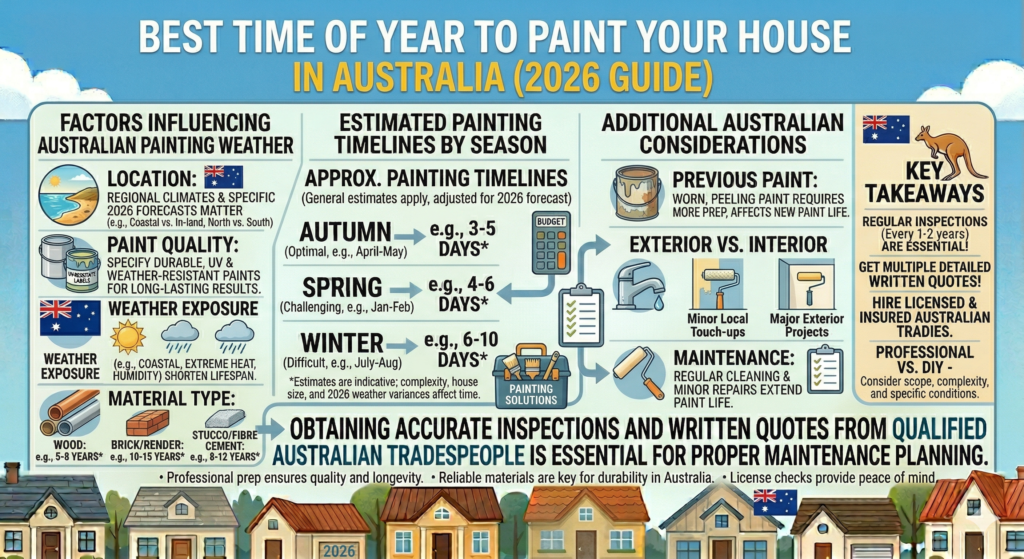
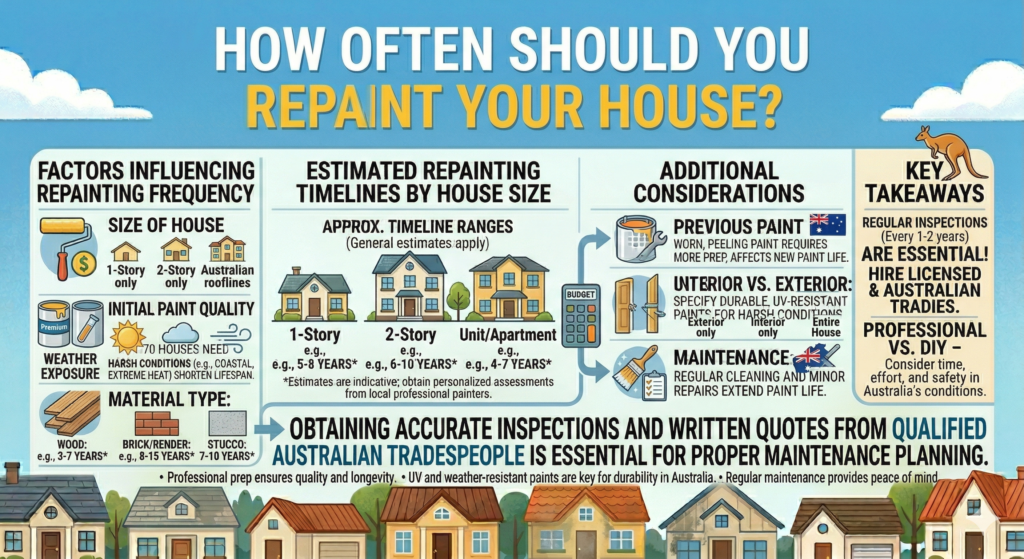
Most Australian homes need exterior repainting every 5 to 10 years and interior repainting every 3 to 7 years – but the right answer depends on your room, your wall type, and where you live. Coastal homes, weatherboard houses, and high-traffic rooms like hallways and kitchens need attention more often. Painted brick and adult bedrooms can go much longer. This guide gives you the exact timelines for each situation.
What’s covered in this guide
- Why repainting is maintenance, not just cosmetic
- Interior repainting – by room
- Exterior repainting – by wall material
- How your climate zone affects the schedule
- Warning signs your house needs repainting now
- Rental property repainting rules in Australia
- How to make your paint last longer
- Should you repaint before selling?
- Frequently asked questions
Most homeowners think about repainting only when something goes wrong – a leak stain on the ceiling, paint peeling off the weatherboard, or a bathroom that’s grown a little too familiar with mould. By that point, you’re already behind.
The smarter approach is to treat painting as a maintenance schedule, not a reaction. A little fresh paint at the right time is cheap. Ignoring the schedule leads to rotting timber, water damage behind walls, and repair bills that make a simple repaint look like a bargain.
This guide gives you the exact timelines Australian homeowners need – broken down by room, by wall type, and by the part of Australia you live in. We’ve also included the warning signs that mean you can’t wait any longer, and practical tips to get more life out of every paint job.
Section 01
Why Repainting Is Maintenance, Not Just a Cosmetic Choice
Fresh paint makes a home look great – but that’s not the main reason to stay on top of it. Paint does a genuinely important protective job: it seals your walls against moisture, UV radiation, salt air, and temperature extremes. When it starts to fail, those forces start attacking the material underneath.
For timber-framed homes and weatherboard houses in particular, this matters enormously. Once water gets behind failing paint and into timber, rot follows. And rot is expensive – home builders and structural repair specialists will tell you that a $600 exterior repaint deferred for three years can easily turn into a $4,000 timber repair job.
For brick and rendered homes, the stakes are slightly lower – but failing exterior paint still allows moisture into the render, causing cracks, efflorescence (salt staining), and eventually structural issues in the render coating itself.
💡 The maintenance mindset
Think of repainting like servicing your car. You don’t wait for the engine to fail – you service it on schedule to prevent failure. The same logic applies to paint. A planned repaint at the right time costs a fraction of what an emergency repair costs when deterioration is left unchecked. According to CHOICE Australia, home maintenance done on schedule is consistently cheaper than reactive repairs.
Section 02
How Often Should You Repaint Interior Walls? (Room by Room)
Not all rooms are equal when it comes to repainting. A hallway takes far more daily punishment than a spare bedroom. A kitchen is exposed to steam, grease, and cleaning chemicals that no bedroom ever faces. Here’s a realistic room-by-room guide for Australian homes.
| Hallways & corridors 2–3 yrs Highest traffic. Scuffs, bumps and handprints build up fast. |
| Trims & doors 3–5 yrs High-touch surfaces show wear before walls. Often need touching up first. |
| Kids’ bedrooms 2–3 yrs Crayon, sticky tape, stickers and toy marks take a toll quickly. |
| Living & dining 5–7 yrs Moderate traffic. Furniture bumps and sunlight are the main factors. |
| Kitchen walls 3–4 yrs Steam, grease and strong cleaning products degrade paint rapidly. |
| Adult bedrooms 7–10 yrs Lowest traffic room in most homes. Quality paint can last a full decade. |
| Bathroom walls 3–5 yrs Moisture and mould are the main enemies. Specialist paint essential. |
| Ceilings 8–10 yrs Least wear. Only repaint if stained, yellowed or water damaged. |
Choosing the Right Paint Finish for Each Room
The finish you choose matters just as much as the colour when it comes to how long your paint lasts. In bathrooms and kitchens, use a semi-gloss or satin finish – they resist moisture and clean easily. In bedrooms and living rooms, low-sheen or flat finishes look beautiful but are harder to wipe clean. Hallways should always be done in at least a satin finish so scuffs can be wiped off without leaving marks.
📌 Tip — painting before your renovation
If you’re planning a bathroom renovation or kitchen renovation, always schedule the painting before new fixtures go in – not after. Painting bare walls is far faster and cheaper than masking around new tapware, tiles and cabinetry. Painting after a renovation adds 20–30% to the labour cost due to all the careful cut-in work required around new fittings.
Section 03
How Often Should You Repaint the Exterior of Your House?
Exterior repainting is more variable than interior work because weather is the main driver – and Australia has some of the most varied and extreme weather conditions in the world. The type of wall material on your home’s exterior is the starting point for working out your repaint schedule.
| Wall Material | Repaint Frequency | Key Risk Factor | Notes |
|---|---|---|---|
| Weatherboard / timber | 3–7 years | Expansion and contraction | Highest maintenance surface. Inspect joints and edges annually. |
| Fibre cement (Hardiflex) | 5–10 years | Moisture at edges | Correct primer is critical. Fails early if improperly sealed. |
| Render / stucco | 5–10 years | Hairline cracking | Inspect for cracks before repainting. Fill and prime before topcoat. |
| Metal cladding | 7–10 years | Rust at scratches or joints | Touch up scratches immediately to prevent rust spreading. |
| Brick (painted) | 10–20 years | Moisture trapping | Longest lasting. Must be sealed correctly or moisture is trapped in. |
⚠ Weatherboard homes – extra vigilance needed
Weatherboard is the most maintenance-intensive exterior surface in Australia. Timber naturally expands in heat and contracts in cold, which stresses the paint film at joints and edges faster than any other surface. Once paint fails at a joint, water can get in behind the boards – and timber rot follows quickly. Inspect your weatherboard home every year, especially at window frames, board ends, and corner joints. Catching a small failure early and doing a spot repair is dramatically cheaper than replacing rotted boards. See our full guide on protecting your home’s exterior from the elements.
What About the Roof?
Painted roofs – including Colorbond, terracotta tile, and concrete tile – have their own repainting schedule. Metal roofs typically need repainting every 10–15 years, while concrete and terracotta tiles benefit from a recoat every 10–12 years to restore their protective surface. You can learn more about roof maintenance schedules in our dedicated roofing guide.
Section 04
How Your Climate Zone Affects the Repaint Schedule
Here’s the part most Australian painting guides skip entirely – and it’s critically important. The exact same paint job on the same wall type will last completely different lengths of time depending on where in Australia your home is located.
This is because paint degrades through UV radiation, moisture cycling, temperature extremes, and airborne salt – and every Australian climate zone delivers a different combination of these forces.
| 🌊 Coastal (within 5 km of ocean) 4–6 years Salt air + UV + wind. The harshest environment for exterior paint in Australia. Annual washing helps extend the cycle. |
| ☀ Subtropical (SE QLD / Northern NSW) 5–8 years High UV and humidity in summer. Salt spray in coastal suburbs of Brisbane and Gold Coast. UV-resistant paint is essential. |
| 🍃 Temperate (VIC / SA / ACT) 7–12 years Most forgiving climate for exterior paint in Australia. Mild conditions allow quality paint to reach its full lifespan. |
| 🌧 Tropical (QLD / NT) 4–7 years Wet season humidity, mould growth, and intense UV cycling. Use tropical-grade paint with anti-mould properties. |
| 🌡 Arid / Inland (outback regions) 6–10 years Extreme heat and intense UV bleach paint fast – but no moisture to deal with. Lighter colours hold up better in full sun. |
| 🌤 Perth / WA (inland) 7–10 years Hot and dry with intense UV but no coastal salt. Good paint holds up well. Coastal Perth suburbs fall into the coastal zone above. |
💡 Why coastal homes are the hardest case
Homes within 5 kilometres of the Australian coastline face a triple threat: salt-laden air that deposits corrosive particles on every surface, intense UV radiation that breaks down paint binders, and wind-driven moisture that gets into every tiny crack. According to Dulux Australia’s coastal painting guide, annual washing with fresh water to remove salt buildup is one of the single most effective things you can do to extend your paint job’s life – often adding 1 to 2 years to the repaint cycle at minimal cost.
Section 05
Warning Signs Your House Needs Repainting Right Now
Don’t wait for your scheduled repaint date if your home is already showing these warning signs. Some of these indicate that paint failure is already allowing damage to progress – and that means the longer you wait, the more expensive the fix becomes.
Exterior Warning Signs
- Chalking – a white powdery residue when you rub the wall. This means the paint binder has broken down and the surface is completely unprotected.
- Peeling or flaking paint – water has already gotten under the paint film. On weatherboard homes, check for timber damage underneath immediately.
- Bubbling or blistering – usually caused by moisture trapped behind the paint, or paint applied over a damp surface. The paint needs to come off and the surface needs to dry and be properly prepared.
- Visible cracking on rendered or stucco walls – water is entering through these cracks. Fill and repaint before the next rain season.
- Fading or colour bleaching particularly on north- and west-facing walls that receive the most direct sun exposure.
- Rust staining on or below metal fixtures, window frames, or joins – indicating corrosion that needs treatment before repainting.
- Mould or lichen growth particularly in shaded or south-facing areas – this holds moisture against the surface and accelerates deterioration.
Interior Warning Signs
- Scuff marks and stains that won’t clean off — the paint has lost its protective sheen and is now absorbing rather than repelling.
- Visible yellowing particularly on ceilings and white trims – often caused by cooking fumes, cigarette smoke, or simply age.
- Mould spots in bathrooms or on external-facing walls – needs a mould-resistant paint and possibly a ventilation improvement.
- Water stain rings on ceilings – always fix the source of the leak first, then repaint with a stain-blocking primer before the final coat.
- Peeling paint in bathrooms – typically caused by inadequate ventilation or the wrong paint type used originally.
🚨 Never paint over these problems
Painting over mould, peeling paint, or water stains without treating the cause first is one of the most common and costly mistakes homeowners make. The new paint will fail within months, and the underlying problem will continue to worsen. Always fix the source of moisture or damage, treat the surface properly, and prime before applying a topcoat. If you’re unsure, a professional painter or licensed building inspector can assess the surface condition before work begins.
Section 06
Rental Property Repainting – What Australian Landlords Need to Know
If you own a rental property in Australia, repainting is a question that comes up regularly – and it has both practical and legal dimensions worth understanding.
Is There a Legal Requirement to Repaint?
There is no specific law in Australia that requires landlords to repaint on a fixed schedule. However, landlords are legally required to maintain their properties in a “reasonably clean and fit for habitation” condition under residential tenancy legislation in every state and territory. If paint has deteriorated to the point where it’s mouldy, peeling, or visibly damaged, this can be considered a maintenance failure under these laws.
📋 Rental property paint schedule – general guide
The industry standard most Australian property managers follow is a full interior repaint every 7 to 10 years for long-term tenancies, or between tenancies when the property shows significant wear. High-traffic areas (hallways, kitchen, laundry) typically need touch-ups or spot repaints every 3 to 5 years. Always document the painted condition with photos in your condition report at the start of every tenancy – this is essential for distinguishing fair wear and tear from tenant-caused damage. For guidance on tenancy maintenance obligations, NSW Fair Trading and the Residential Tenancies Authority Queensland publish clear guides for landlords.
Fair Wear and Tear vs Tenant Damage
Australian tenancy law distinguishes between “fair wear and tear” – normal deterioration over time – and damage caused by tenants. Paint scuffs from furniture, minor nail holes, and fading from sunlight are generally considered fair wear and tear. Large gouges, unauthorised paint colours applied by the tenant, or extensive crayon or marker damage may be recoverable as tenant damage. Document everything thoroughly at the start and end of each tenancy.
Section 07
How to Make Your Paint Job Last Longer in Australia
You don’t have to repaint on the shortest possible schedule. With the right choices in paint, prep, and maintenance, you can reliably extend your repaint cycle — sometimes by years. Here are the most effective strategies:
1. Invest in Proper Surface Preparation
This is the single biggest factor in paint longevity. No matter how expensive the paint, it will fail early on a poorly prepared surface. Good preparation means washing the surface to remove dirt, salt, and mould; sanding rough or chalky areas; filling cracks and holes; and priming bare or repaired surfaces. Professional painters will tell you that prep work takes as long as – or longer than – the actual painting, and it’s worth every hour. According to the Housing Industry Association, properly prepared surfaces can extend paint life by 30–50%.
2. Choose Premium Paint for Exterior Surfaces
The difference in price between a budget exterior paint and a premium product like Dulux Weathershield or Wattyl Solagard is often $15–$25 per litre. But premium paints typically last 2 to 4 years longer on exterior surfaces – which, when you factor in the labour cost of repainting, represents enormous value. Never use interior paint on exterior surfaces – the formulations are completely different and interior paint will fail outdoors within 1 to 2 years.
3. Wash Exterior Walls Annually
A simple annual wash with a mild detergent and a hose (or pressure washer on a low setting) removes the salt deposits, dust, and mould spores that gradually break down paint. This is especially important for coastal homes, where salt buildup is constant. Annual washing costs almost nothing and can add 1 to 3 years to your repaint cycle.
4. Touch Up Damage Promptly
A small chip or scratch on exterior paint is an invitation for water and salt to get behind the paint film and start the peeling process from underneath. Touch up any chips, cracks, or damaged areas within weeks of noticing them – not months. Keep a small quantity of your exterior paint in a sealed, labelled tin for exactly this purpose.
5. Improve Ventilation in Wet Areas
Most bathroom and kitchen paint failures in Australia are caused by moisture – specifically by inadequate ventilation allowing steam and humidity to sit against painted surfaces. Installing or upgrading exhaust fans in bathrooms and running the range hood during cooking will noticeably extend your interior paint’s life in these rooms.
Section 08
Should You Repaint Before Selling Your Home in Australia?
In most cases, yes – but strategically, not comprehensively. You don’t need to repaint every surface in your home before listing it. You need to repaint the surfaces that buyers actually look at and judge.
Where to Focus Your Pre-Sale Repainting Budget
- The front facade – first impressions form within seconds. A freshly painted exterior front (even if you don’t do the full exterior) significantly improves buyer perception at first view.
- The front door and entry – an often-overlooked high-impact detail. A crisp, fresh front door sets the tone for the entire inspection.
- Kitchen and living room – the rooms where buyers spend most of their inspection time. Fresh neutral paint here creates a “move-in ready” impression that buyers respond to strongly.
- Master bedroom – the second most scrutinised room after the kitchen in most Australian buyer inspections.
- Any room with visible water stains, mould, or peeling paint – these are red flags that trigger concern about the property’s maintenance history and can generate requests for price reductions.
💡 Colour choice matters for pre-sale painting
Always use neutral, warm tones for pre-sale painting – warm whites, soft greys, and warm off-whites. Avoid strong accent colours or anything too personal. The goal is to help buyers imagine their own belongings in the space, not to express your personal taste. Ask your real estate agent which colours are performing best with buyers in your specific suburb – this varies by area and price point. Our guide on pre-sale home improvements that add value covers this in more depth.
Section 09
Frequently Asked Questions