Hot water is one of those things you never think about – until it stops working. Whether your system has just died or you can see the warning signs building up, one of the first questions you will ask is: how much is this going to cost me?
The answer depends on the type of system you choose, the size of your home, your location, and whether any government rebates apply. In this guide, we break down every cost in plain English – from the cheapest electric system to premium solar options – so you can make a confident, informed decision.
Planning a broader bathroom or kitchen renovation at the same time? Visit our bathroom renovation guides and kitchen renovation guides to help you budget for the full project.
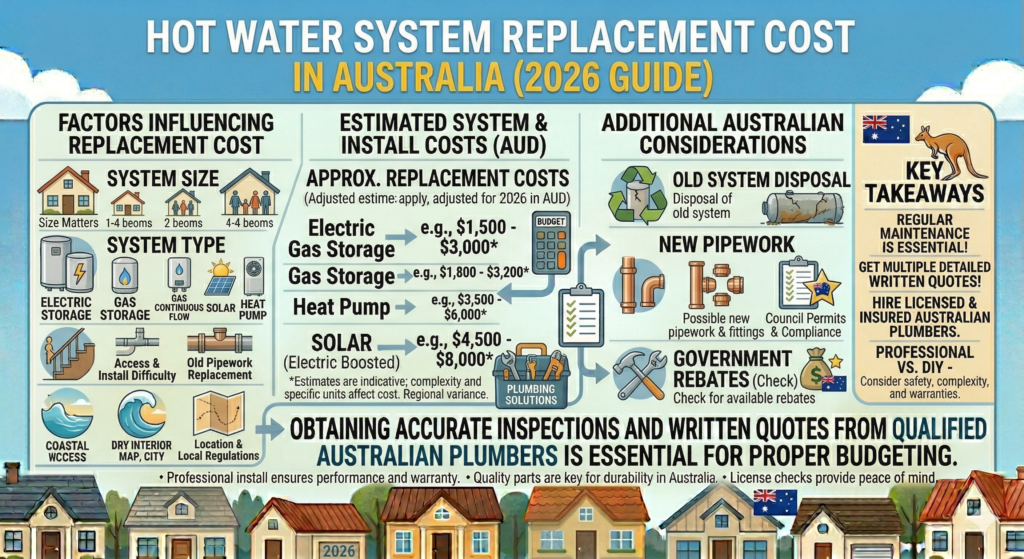
Hot Water System Replacement Cost – Quick Price Comparison (2026)
Here is a snapshot of the four main types of hot water systems in Australia and what they typically cost – including installation – in 2026.
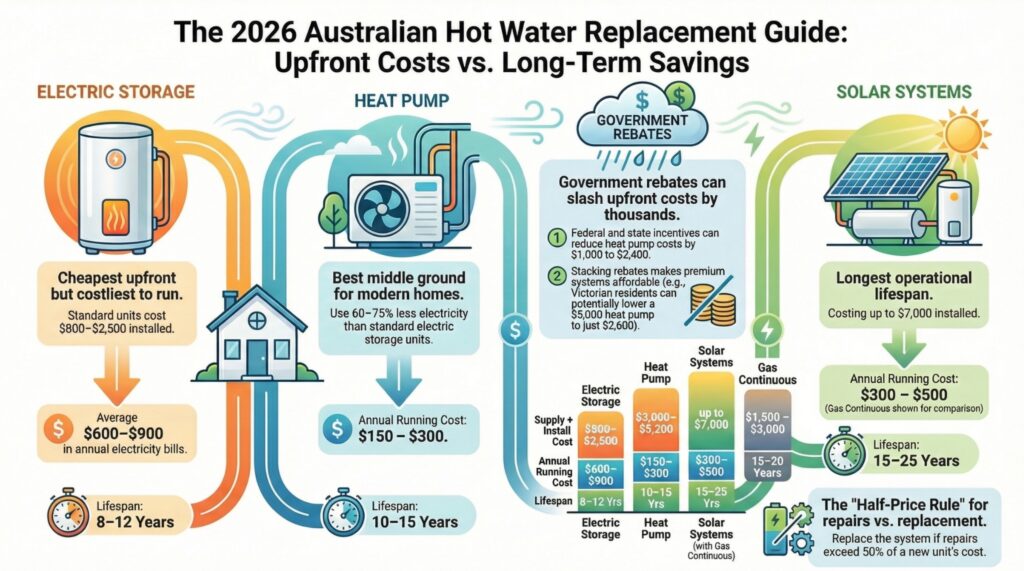
| System Type | Supply + Install Cost | Annual Running Cost | Lifespan |
| Electric storage (standard) | $800 – $2,500 | $600 – $900/year | 8–12 years |
| Gas storage (mains gas) | $1,200 – $3,000 | $350 – $550/year | 10–15 years |
| Gas continuous flow (instantaneous) | $1,500 – $3,000 | $300 – $500/year | 15–20 years |
| Heat pump | $3,000 – $5,200 (before rebates) | $150 – $300/year | 10–15 years |
| Solar hot water | $3,000 – $7,000+ (before rebates) | $100 – $250/year | 15–25 years |
| 💡 Quick Answer: The cheapest hot water system to buy and install in Australia is an electric storage system, starting from around $800. However, when you include running costs over 10 years, heat pump and gas systems are often cheaper overall. Government rebates can also significantly reduce the upfront cost of heat pumps and solar systems. |
Types of Hot Water Systems in Australia – Explained Simply
There are four main types of hot water systems available in Australia. Here is what each one does, what it costs, and who it suits best.
1. Electric Storage Hot Water System
An electric storage system heats water using an electric element inside a tank and keeps it ready to use. It is the most common and affordable hot water system in Australia – and the easiest to install because it does not need a gas connection.
| Detail | Information |
| Supply + installation cost | $800 – $2,500 |
| Annual running cost | $600 – $900/year |
| Lifespan | 8 to 12 years |
| Best for | Homes without gas, rental properties, low-budget replacements |
| Government rebates? | Not eligible for major rebates – but off-peak tariffs reduce running costs |
The main downside of electric storage systems is that they are the most expensive to run. They constantly heat a full tank of water, even when you do not need it. If you can stretch your budget to a heat pump, you will save significantly on energy bills within a few years.
2. Gas Storage Hot Water System
A gas storage system heats water using a gas burner at the base of the tank. They heat water faster than electric systems and are cheaper to run, making them a popular mid-range choice across most of Australia.
| Detail | Information |
| Supply + installation cost | $1,200 – $3,000 |
| Annual running cost | $350 – $550/year |
| Lifespan | 10 to 15 years |
| Best for | Homes with existing gas connection, families with high hot water demand |
| Government rebates? | Limited – check your state energy authority for current offers |
| ⚠ Victoria Gas Ban – Important: From 1 March 2027, Victorian homes whose gas hot water system reaches end of life must replace it with an electric alternative (heat pump or electric storage). If you are in Victoria, 2026 is the last year to plan your replacement on your own terms with full rebate access. Check the Victorian Building Authority for the latest details. |
3. Gas Continuous Flow (Instantaneous) System
Continuous flow systems – also called instantaneous or tankless systems – heat water only when you turn on the tap. There is no storage tank, which means no energy wasted keeping water hot. They are compact and can supply endless hot water, making them ideal for larger families.
| Detail | Information |
| Supply + installation cost | $1,500 – $3,000 |
| Annual running cost | $300 – $500/year |
| Lifespan | 15 to 20 years |
| Best for | Larger households, homes with limited space, those wanting endless hot water |
| Government rebates? | Some state-level gas efficiency rebates – check your state authority |
The main limitation is that continuous flow systems require a gas connection and sufficient gas pressure. They are not suitable for homes on LPG (bottled gas) or properties without mains gas.
4. Heat Pump Hot Water System – Best Long-Term Value
A heat pump works like a reverse air conditioner – it pulls heat from the surrounding air and uses it to warm your water, using far less electricity than a standard electric system. Heat pumps have become the fastest-growing hot water choice in Australia in 2026, largely because of generous government rebates and dramatically lower running costs.
| Detail | Information |
| Supply + installation cost (before rebates) | $3,000 – $5,200 |
| Cost after federal STC rebate | Approximately $2,000 – $4,200 |
| Annual running cost | $150 – $300/year |
| Lifespan | 10 to 15 years |
| Best for | Most Australian homes – especially those replacing old electric storage systems |
| Government rebates? | ✅ Yes – federal STC rebate (~$1,000) + state-level rebates up to $1,400 in VIC |
| ✅ Why Heat Pump is the Smart Choice in 2026: A heat pump uses 60 to 75 percent less electricity than a standard electric storage system. On an average household, that means saving $400 to $700 per year on energy bills. After government rebates, the upfront cost gap between electric and heat pump narrows significantly – often making heat pump the smarter financial choice within 3 to 5 years. |
5. Solar Hot Water System
Solar hot water systems use roof-mounted solar collectors to absorb heat from the sun and transfer it to a storage tank. They are the most energy-efficient option available and have very low running costs once installed. The trade-off is the high upfront cost and the need for adequate roof space and sun exposure.
| Detail | Information |
| Supply + installation cost | $3,000 – $7,000+ |
| Annual running cost | $100 – $250/year (with electric or gas booster for cloudy days) |
| Lifespan | 15 to 25 years (solar panels last longer than the tank) |
| Best for | Homes in high-sun areas, environmentally conscious homeowners, long-term investment |
| Government rebates? | ✅ Yes – federal STCs and state rebates up to $1,400 available |
Solar systems are best suited to homes with north-facing roofs, adequate roof space, and locations with consistent sun – making them excellent across Queensland, Northern Territory, Western Australia, and South Australia. In cloudy southern states like Victoria and Tasmania, a heat pump often delivers better value.
What Is Included in a Hot Water System Replacement Cost?
When a plumber quotes you for a hot water system replacement, the total price typically includes the following:
| What Is Included | Typical Cost |
| New hot water unit (supply only) | $400 – $3,500+ depending on type |
| Labour — licensed plumber | $80 – $120 per hour (2–4 hours typical) |
| Electrical work (if required) | $100 – $400 (heat pump or electric system upgrade) |
| Removal and disposal of old system | $80 – $200 |
| Tempering valve (legally required in most states) | $80 – $150 |
| Compliance certificate | $50 – $150 |
| Plumbing connections and fittings | $100 – $300 |
| Scaffolding (solar systems only) | $200 – $500 |
| ⚠ Always Get a Written Itemised Quote: Never accept a verbal quote for a hot water system replacement. A legitimate licensed plumber will provide a written itemised quote that clearly shows the unit cost, labour, disposal, and any compliance fees separately. This protects you from hidden costs and gives you a clear basis for comparison. |
Hot Water System Replacement Cost by City
Labour rates and material availability vary across Australia. Here is a realistic guide to what you can expect to pay in major cities for a standard electric storage replacement:
| City | Electric Storage | Gas Storage | Heat Pump (after rebates) | Notes |
| Sydney / NSW | $1,200 – $2,000 | $1,800 – $3,000 | $2,000 – $4,000 | ESS rebate up to $1,000 available |
| Melbourne / VIC | $1,100 – $1,900 | $1,600 – $2,800 | $1,500 – $3,200 | Best rebates in Australia – VEU + Solar VIC |
| Brisbane / QLD | $1,000 – $1,800 | $1,500 – $2,700 | $2,000 – $3,800 | Hot climate favours heat pump and solar |
| Perth / WA | $1,000 – $1,900 | $1,400 – $2,600 | $2,000 – $3,800 | Good sun exposure – solar also worth considering |
| Adelaide / SA | $900 – $1,700 | $1,300 – $2,500 | $1,800 – $3,500 | SA rebates available – check energy.sa.gov.au |
| Canberra / ACT | $1,200 – $2,100 | $1,800 – $3,000 | $1,500 – $3,000 | ACT has generous heat pump rebates |
| Darwin / NT | $1,200 – $2,200 | Limited gas supply | $2,200 – $4,000 | Solar excellent – high sun hours year-round |
| Hobart / TAS | $1,000 – $1,800 | $1,500 – $2,600 | $2,000 – $3,600 | Heat pump suits TAS climate – uses ambient air heat |
Government Rebates That Can Reduce Your Cost
This is where many Australian homeowners leave money on the table. There are both federal and state-level rebates available in 2026 that can significantly reduce the cost of upgrading to a heat pump or solar hot water system.
Federal STC Rebate (All States)
The federal government’s Small-scale Technology Certificate (STC) scheme provides a rebate for energy-efficient hot water systems including heat pumps and solar systems. In 2026, this typically reduces the upfront cost of a heat pump by around $800 to $1,000 and is usually applied as a point-of-sale discount – meaning your plumber deducts it from your invoice automatically.
State-Level Rebates
| State | Program | Rebate Amount | Eligible Systems |
| Victoria | VEU + Solar Victoria Rebate | Up to $1,000 (VEU) + up to $1,400 (Solar VIC) | Heat pumps and solar |
| NSW | Energy Savings Scheme (ESS) | $600 – $1,000 | Heat pumps replacing electric systems |
| Queensland | Queensland Energy and Jobs Plan | Varies – check energex.com.au | Heat pumps and solar |
| South Australia | Energy Efficiency Scheme | Varies – check sa.gov.au/energy | Heat pumps and solar |
| ACT | Sustainable Household Scheme | Up to $2,500 interest-free loan + rebate | Heat pumps and solar |
| WA / TAS / NT | Contact state energy authority | Varies by year and program | Heat pumps and solar |
For the most up-to-date rebate information for your state, visit the Australian Government Energy website which lists current federal and state programs in one place.
| 💡 Rebates Can Change the Maths Completely: In Victoria, stacking the federal STC rebate (~$1,000) with the VEU rebate ($1,000) and Solar Victoria rebate (up to $1,400) means you could get a $5,000 heat pump system for as little as $2,600. In NSW, the ESS rebate alone can reduce a heat pump from $4,500 to $3,500 or less. Always ask your plumber about available rebates before accepting a quote. |
Signs You Need to Replace Your Hot Water System
Not sure if you need a full replacement or just a repair? Here are the clear signs that tell you a replacement is the right call:
- Your system is more than 10 years old – most electric and gas storage systems last 8 to 12 years. If yours is approaching that age, it is living on borrowed time.
- The tank is leaking – a leaking tank always means full replacement. There is no repair that fixes a corroded or cracked tank.
- You are getting rusty or discoloured water – this usually means the tank is corroding internally. Do not ignore this – it is a health and structural issue.
- You are running out of hot water faster than usual – a sign the heating element or thermostat is failing.
- Unusual rumbling, popping, or banging noises – sediment buildup in the tank, which reduces efficiency and signals the end of the system’s life.
- Your energy bills have risen without explanation – an ageing hot water system working harder than normal will push up your electricity or gas bill.
| ⚠ Repair vs Replace Rule of Thumb: If the repair cost is more than half the price of a comparable new system – replace it. For example, if your 10-year-old electric storage system needs a $600 element replacement and a new comparable system costs $1,000, replacement is the smarter decision. You get a full warranty and reset the clock on the system’s lifespan. |
What Size Hot Water System Do I Need?
Getting the right size system is just as important as choosing the right type. A system that is too small will run out of hot water. A system that is too large wastes energy heating more water than you use.
| Household Size | Recommended Tank Size | System Type Recommendation |
| 1–2 people | 125 – 160 litres | Electric storage or heat pump (150L) |
| 2–3 people | 160 – 250 litres | Gas storage, heat pump (200–250L), or continuous flow |
| 3–4 people | 250 – 315 litres | Heat pump (270–315L), gas storage, or solar |
| 4–5 people | 315 – 400 litres | Heat pump (315–400L), solar, or large gas continuous flow |
| 5+ people | 400 litres + | Solar system with booster, or large gas continuous flow |
Not sure what type of system suits your home? CHOICE Australia – one of Australia’s most trusted consumer advocacy organisations – has an independent comparison of all system types that can help you decide.
How to Save Money on Hot Water System Replacement
Here are practical, proven ways to reduce the cost of your replacement without cutting corners on quality:
- Get at least 3 quotes – prices can vary by $500 to $1,500 for the same job depending on the plumber.
- Always ask about government rebates – many homeowners miss out simply by not asking. A reputable plumber will know what rebates apply and deduct them at the point of sale.
- Replace like-for-like where possible – switching from electric to gas or from gas to solar involves additional electrical or plumbing work that adds cost. If you are not upgrading the system type, a like-for-like replacement is simpler and cheaper.
- Book a planned replacement, not an emergency one – emergency call-outs typically add $150 to $500 to your bill. If your system is showing warning signs, plan ahead.
- Bundle with a bathroom renovation – if you are already renovating your bathroom, adding a hot water system replacement to the same job can save on labour and call-out fees.
- Choose an accredited installer for rebate eligibility – to qualify for STC and state rebates, your system must be installed by a Clean Energy Council (CEC) accredited installer.
- Check energy star ratings – a higher energy star rating means lower running costs. A system with a 4-star energy rating can save hundreds of dollars per year over a 2-star system.
If you are planning a full bathroom renovation and want to upgrade your hot water system at the same time, read our bathroom renovation cost guide for a full breakdown of what to budget for.
To verify a plumber’s licence before booking, visit the Clean Energy Council’s accredited installer database for heat pump and solar installers, or check your state building regulator for general plumbing licences.
Frequently Asked Questions
Here are the most common questions Australians ask about hot water system replacement costs.
Final Thoughts
Hot water system replacement in Australia in 2026 can cost anywhere from $800 for a basic electric system to over $7,000 for a premium solar setup. The right choice depends on your budget, your household size, your energy supply, and how long you plan to stay in your home.
For most Australian households, a heat pump hot water system offers the best combination of upfront affordability (especially after rebates), low running costs, and long-term value. If budget is the only priority, a quality electric storage system is a reliable and straightforward option.
Whatever you choose – always get at least 3 written quotes, ask about government rebates, and use a licensed plumber. A hot water system is a daily essential. Getting it right the first time saves you money, hassle, and cold showers for years to come.
For more practical home improvement guides for Australian homeowners, visit Home Improvement Australia – including guides on bathroom renovations, kitchen renovations, home building, and roofing advice.