One of the most common questions Australian homeowners ask before starting a kitchen renovation is not “how much will it cost?” – it is “how long will we be without a kitchen?”
It is a fair concern. The kitchen is the heart of your home. Packing lunches, making coffee, cooking dinner – all of that stops the moment your kitchen is pulled apart. Knowing the realistic timeline before you start helps you plan properly, set up a temporary kitchen, and avoid unnecessary stress.
In this guide, we break down exactly how long a kitchen renovation takes in Australia in 2026 – from the first design meeting to cooking your first meal in the new space – in plain, simple language.
Not sure what your kitchen renovation will cost? Read our full kitchen renovation cost guide for Australia (2026) for a complete breakdown by budget tier, component, and city.
Quick Answer – Kitchen Renovation Timelines at a Glance
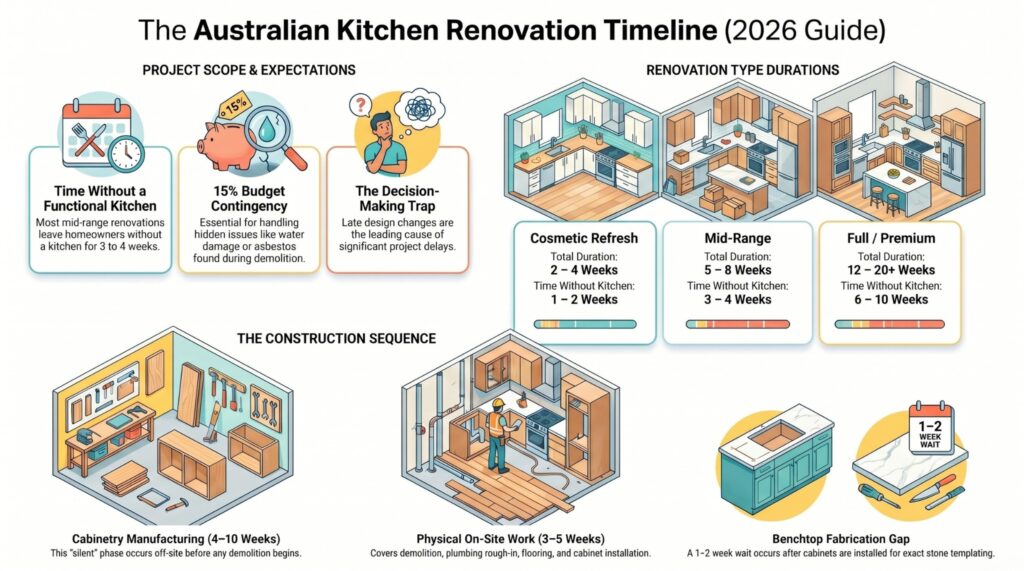
Every kitchen renovation is different, but here is a realistic summary of how long each type of renovation takes in Australia:
| Renovation Type | Total Project Duration | Time Without a Kitchen |
| Cosmetic refresh (new doors, benchtop, splashback – no layout changes) | 2 – 4 weeks total | 1 – 2 weeks |
| Mid-range renovation (new cabinetry, stone benchtop, minor plumbing / electrical) | 5 – 8 weeks total | 3 – 4 weeks |
| Full renovation (layout changes, new cabinetry, all trades) | 8 – 12 weeks total | 5 – 7 weeks |
| Premium / custom renovation (structural work, bespoke joinery, full redesign) | 12 – 20+ weeks total | 6 – 10 weeks |
| 💡 Quick Answer: Most Australian homeowners doing a standard mid-range kitchen renovation are without a fully functioning kitchen for 3 to 4 weeks. The total project timeline – from signing a contract to final touches – is typically 6 to 10 weeks for a mid-range renovation, and 12 to 20 weeks for a full custom renovation with layout changes. |
The Kitchen Renovation Timeline – Stage by Stage
A kitchen renovation does not happen all at once. It moves through a clear sequence of stages, each one building on the last. Here is exactly what happens and how long each stage takes:
Stage 1 – Planning and Design (2 to 6 Weeks Before Work Starts)
Before any tradesperson sets foot in your home, you spend time planning. This stage happens well before demolition and is the most important one for avoiding delays later.
| What Happens | Typical Time |
| First meeting with kitchen company or builder – discuss layout, style, budget | Week 1 |
| Designer produces kitchen layout drawings and 3D renders | 1 – 2 weeks |
| You review, provide feedback, and approve the final design | 3 – 7 days |
| Quote is finalised and contract is signed | 3 – 5 days |
| Cabinetry is ordered – manufacturing lead time begins | Immediately after signing |
| ⚠ The Biggest Timeline Mistake Australians Make: Most kitchen renovation delays in Australia start here – not during construction. Homeowners take weeks or months to finalise design decisions, delay signing off, or change their minds after placing orders. Every week you delay approving the design is a week added to the end of your project. Make decisions and stick to them. |
Stage 2 – Cabinetry Manufacturing Lead Time (4 to 10 Weeks)
This is the stage most homeowners do not know about – and it is the one that most often causes surprise delays.
Custom kitchen cabinetry is not kept on a shelf. It is manufactured specifically for your kitchen after you approve the design. This takes time. Here is what to expect:
| Cabinet Type | Manufacturing Lead Time |
| Flat-pack (IKEA, Kaboodle, Freedom Kitchens) | Usually in stock or available within 1 – 2 weeks |
| Semi-custom (standard sizes, custom colours / finishes) | 4 – 6 weeks after order |
| Fully custom joinery (bespoke, made to measure) | 6 – 10 weeks after order |
This lead time runs in parallel with the planning and permit stage. The smart move is to finalise your cabinetry order as early as possible – ideally the same week you sign your contract – so that by the time your kitchen is demolished and prepped, the cabinets are ready to install.
Stage 3 – Permits and Council Approvals (0 to 8 Weeks)
Most cosmetic kitchen renovations in Australia do not require council permits. But if your renovation involves any of the following, you will likely need building or plumbing permits – and this adds time to the front end of your project:
- Removing or altering load-bearing walls
- Relocating the sink, cooktop, or dishwasher to a different position
- Relocating gas lines
- Adding a new window or changing the kitchen footprint
| Work Type | Permit Required? | Approval Time |
| Cosmetic update – no layout changes | ❌ Usually not required | No waiting time |
| New cabinetry in same position, no plumbing relocation | ❌ Usually not required | No waiting time |
| Plumbing relocation (sink or dishwasher moved) | ⚠ Plumbing permit required | 1 – 3 weeks for approval |
| Wall removal (non-structural) | ⚠ Building permit likely required | 2 – 6 weeks for approval |
| Structural changes (remove load-bearing wall) | ✅ Building permit required | 4 – 8 weeks for approval |
| 💡 Permit Tip: If you suspect your renovation might need permits, apply for them as early as possible – even before your cabinetry is ordered. Permit approval can take 4 to 8 weeks, and you cannot start construction until they are in place. A good builder or kitchen company will manage this process for you. |
Stage 4 – Demolition (1 to 3 Days)
Once your cabinetry is ordered and permits are in place, physical work begins with demolition. This is when your old kitchen comes out.
- Old cabinets, benchtops, and splashback are removed
- Appliances are disconnected and taken away
- The sink is disconnected from water and drainage
- Flooring may be removed if you are replacing it
- The space is assessed for any hidden issues – water damage, old wiring, asbestos
Demolition itself is fast – usually one to two days for a standard kitchen. But what is found during demolition can add time. Water damage under the old sink, old wiring that does not meet current standards, or damaged subfloor can each add days or weeks to your project. This is why experienced renovators always budget a 15 percent contingency.
Stage 5 – Plumbing and Electrical Rough-In (3 to 7 Days)
After demolition, the first trades on site are the plumber and electrician. They work on the “rough-in” – setting up the pipes, drainage connections, and electrical wiring before any walls are closed up or cabinets installed.
| Trade Work | Typical Duration |
| Plumber – rough-in (if plumbing is being relocated) | 2 – 4 days |
| Plumber – like-for-like (sink stays in same position) | Half a day to 1 day |
| Electrician – new circuits, powerpoints, lighting rough-in | 1 – 3 days |
| Gas fitter – cooktop connection or relocation | Half a day to 2 days |
Stage 6 – Plastering and Waterproofing (2 to 5 Days)
Once plumbing and electrical rough-in is done, any damaged walls or new wall sections need to be plastered. If you have an area where water splash is possible – around the sink or dishwasher – waterproofing is applied before any tiling.
- Plastering damaged walls after electrical or plumbing work: 1 to 3 days including drying time
- Waterproofing under-sink and splash zones: half a day to 1 day application, then 24 to 48 hours drying
Stage 7 – Flooring Installation (2 to 5 Days)
If you are replacing the kitchen floor, it is typically installed before the cabinets go in – so the finished floor runs under the cabinets for a clean, professional look.
- Vinyl planks (click-lock): 1 to 2 days for a standard kitchen
- Ceramic or porcelain tiles: 2 to 4 days including grouting and drying time
- Timber flooring: 2 to 3 days plus finishing time
Stage 8 – Cabinet Installation (1 to 3 Days)
Cabinet installation is one of the most satisfying stages – your kitchen starts to look like a kitchen again. The time it takes depends on the size and complexity of your kitchen.
- Small to medium kitchen (up to 10 linear metres of cabinetry): 1 to 2 days
- Large kitchen or kitchen with island bench: 2 to 3 days
- Flat-pack cabinets: sometimes faster if pre-assembled; sometimes slower if assembled on site
| 💡 Good to Know: After cabinets are installed, the stone, engineered stone, or porcelain benchtop fabricator comes to measure (called templating). This is when they take exact measurements to cut your benchtop to fit. The benchtop cannot be templated until the cabinets are fully installed — and the actual benchtop usually takes 1 to 2 weeks to be fabricated and delivered after templating. This sequence is one of the main reasons projects feel slow in the middle. |
Stage 9 – Benchtop Installation (1 to 2 Days After Delivery)
Once the benchtop is delivered – 1 to 2 weeks after templating for standard engineered stone, longer for natural stone or Dekton – installation itself is relatively quick: typically one day for a standard kitchen.
- Engineered stone / quartz: Available within 1 to 2 weeks of templating
- Natural stone (marble, granite): 2 to 3 weeks lead time after templating
- Dekton or porcelain slab: 2 to 3 weeks – confirm lead time before ordering
- Laminate or timber: Usually installed same day as cabinets by your cabinetmaker
Stage 10 – Splashback, Lighting and Final Trades (3 to 7 Days)
With the cabinets and benchtop in, the final finishes come together quickly. This is the stage where your kitchen really starts to look finished.
| Final Stage Work | Typical Time |
| Tiled splashback – tiling and grouting | 2 – 3 days |
| Glass splashback – measure, fabricate, and install | 5 – 10 days (measuring + fabrication lead time) |
| Electrician returns – connect appliances, install lights, fit powerpoints | Half a day to 1 day |
| Plumber returns – connect sink, dishwasher, tapware | Half a day to 1 day |
| Painter – touch-ups, ceiling, and any new wall sections | 1 – 2 days |
| Hardware installation – handles, soft-close hinges, drawer runners | 1 – 2 hours |
Stage 11 – Final Inspection and Handover (1 Day)
The last stage is a walkthrough with your kitchen company or builder. They check everything works properly – cabinets open and close correctly, appliances are connected, taps run, all electrical is functioning – and fix any minor issues found.
Once you are happy, the renovation is complete and the kitchen is yours.
Complete Week-by-Week Timeline – Mid-Range Kitchen Renovation
Here is what a typical 7 to 8 week mid-range kitchen renovation looks like in Australia from contract signing to completion:
| Week | What Happens | Are You Without a Kitchen? |
| Weeks 1 – 2 (pre-construction) | Design finalised, cabinetry ordered, permits applied for (if needed), trades booked | No – kitchen still in use |
| Weeks 3 – 6 (waiting period) | Cabinetry is being manufactured. No on-site work. This is the quiet period. | No – kitchen still in use |
| Week 7, Day 1 – 2 | Demolition – old kitchen removed, skip bin arrives, old appliances disconnected | Yes – kitchen is down from Day 1 |
| Week 7, Day 3 – 5 | Plumber and electrician rough-in, gas fitter (if needed), plastering | Yes |
| Week 8, Day 1 – 2 | Flooring installation (if replacing floor) | Yes |
| Week 8, Day 3 – 5 | Cabinet installation | Yes – but kitchen starts to take shape |
| Week 8 end / Week 9 Day 1 | Benchtop templating (fabricator visits to measure) | Yes |
| Weeks 9 – 10 (waiting) | Benchtop being fabricated – usually 1 to 2 weeks | Yes – sink not yet connected |
| Week 10 – 11 | Benchtop delivered and installed, splashback tiled, electrician and plumber return to connect everything | Almost done – sink reconnected |
| Week 11 – 12 | Lighting fitted, painter touches up, handles installed, final inspection and handover | ✅ Kitchen back in full use |
What Causes Kitchen Renovation Delays in Australia?
Even well-planned renovations can run longer than expected. Here are the most common causes of delays – and what you can do about each one:
| Cause of Delay | How Long It Can Add | How to Avoid It |
| Late decisions – changing your mind on cabinets, benchtop, or appliances after ordering | 1 – 6+ weeks | Finalise all selections BEFORE signing the contract. Lock in choices early. |
| Custom cabinetry lead time longer than expected | 1 – 4 weeks | Order cabinetry the same week you sign. Do not wait. |
| Permit delays – council approval takes longer than anticipated | 2 – 6 weeks | Apply for permits early, before demo is scheduled. |
| Benchtop availability – preferred stone colour is out of stock | 1 – 3 weeks | Confirm benchtop availability before committing. Have a backup choice. |
| Hidden issues found during demolition (water damage, asbestos, old wiring) | 1 – 4 weeks | Budget a 15% contingency. Have an asbestos inspection in homes built before 1990. |
| Tradesperson scheduling gaps – one trade finishes but the next is not available for days | 3 – 7 days | Use a builder or kitchen company that coordinates all trades. Avoid managing trades yourself. |
| Appliance delivery delay – backordered model takes longer to arrive | 1 – 4 weeks | Order appliances before demolition starts. Confirm delivery dates with the retailer. |
| Weather delays (rare for kitchen renovations — mainly affects exterior trades) | 1 – 3 days | Generally not a factor for internal kitchen work |
| ⚠ The Single Biggest Delay in Australian Kitchen Renovations: Late decision-making is the number one cause of blown-out timelines – not the trades, not the materials. Every change made after the cabinetry has been ordered creates a ripple effect. A change to a cabinet size can take 3 to 4 weeks to re-manufacture. A change to the benchtop colour after templating means a new template and another 2 week fabrication cycle. Make all your decisions before you sign the contract and do not change them. |
How to Survive Without a Kitchen During Your Renovation
Being without a kitchen for 3 to 5 weeks is genuinely manageable if you plan ahead. Here are practical tips from experienced Australian renovators:
Set Up a Temporary Kitchen
Before demolition day, set up a simple temporary kitchen station somewhere else in your home – the laundry, a spare room, or even the garage. You need:
- A microwave (the most important appliance – you can cook almost anything in one)
- A kettle for tea, coffee, and hot water
- A small bar fridge if your main fridge is being relocated
- A portable electric cooktop (induction or coil) – very useful for cooking pasta, heating soup, and frying
- Paper plates and disposable cups for the messiest weeks
- A small sink or large tub with access to a bathroom tap for basic washing up
Meal Planning Strategies
The weeks without a kitchen do not have to mean takeaway every night. With a little planning:
- Batch cook in the weeks before demolition and freeze meals – soups, curries, and casseroles all reheat perfectly in a microwave
- Embrace BBQ season – if you have an outdoor BBQ, this is its time to shine
- Budget for a reasonable amount of takeaway and restaurant meals – factor this into your renovation budget
- Supermarket salads, sushi, pre-made meals, and deli items become your friends during the cabinet installation phase
Protecting the Rest of Your Home
- Ask your builder to seal doorways with plastic sheeting during demolition – dust travels further than you think
- Remove anything fragile or valuable from nearby rooms before demolition day
- Ask tradespeople to use drop sheets in hallways and on stairs
- Arrange pet care if you have animals – renovation sites are stressful and potentially dangerous for pets
How to Speed Up Your Kitchen Renovation
If you want your renovation completed as quickly as possible, here is what actually makes a difference:
- Finalise every single decision before you sign the contract – cabinets, benchtop, appliances, splashback, flooring, tapware, and lighting. No changes after signing.
- Order your cabinetry on the same day you sign the contract – do not wait a week
- Choose flat-pack or semi-custom cabinets – they have shorter lead times than full custom joinery
- Pick a benchtop colour that is in stock – confirm with your supplier before committing
- Order your appliances before demolition starts – confirm delivery dates will align with installation
- Choose a kitchen company that manages all trades – instead of coordinating a carpenter, plumber, electrician, and tiler yourself
- Apply for any permits before scheduling demolition
- Be available and responsive – your builder or kitchen company needs you to make quick decisions to keep the project moving
Thinking about other renovation projects running alongside your kitchen? Read our bathroom renovation guide and home improvement planning articles for advice on coordinating multiple renovations in your home at the same time.
Frequently Asked Questions
Here are the most common questions Australians ask about kitchen renovation timelines.
Final Thoughts
A kitchen renovation does not have to be the chaotic, open-ended disruption that many homeowners fear. With a clear understanding of the timeline, the key stages, and what causes delays, you can plan around it effectively.
The most important things to remember are: order your cabinetry as early as possible, make all your design decisions before demolition day, set up a temporary kitchen before the old one comes out, and build a 15 percent contingency into your budget for any hidden surprises.
For a standard mid-range renovation, you are looking at 6 to 10 weeks total – and only 3 to 5 weeks of real disruption. For most Australian homeowners, that is a very manageable trade-off for a kitchen that will serve your family well for the next 15 to 20 years.
For more kitchen renovation guidance, visit our kitchen renovation articles – including our detailed guide on how much a kitchen renovation costs in Australia (2026). You can also explore our bathroom renovation guides, plumbing cost guides, and home improvement planning resources for more practical advice for Australian homeowners.