Renovation dust is easy to ignore next to the budget and the timeline. Some of it can do lasting damage to the people breathing it.
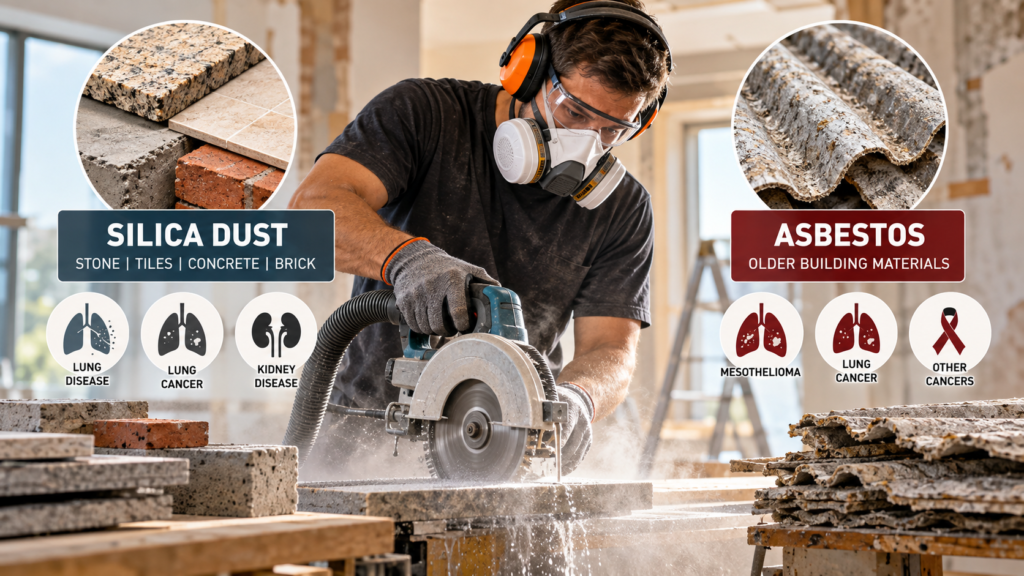
This guide covers two kinds of renovation dust: silica dust from stone, tiles, concrete and brick, and asbestos fibres from older building materials.
Why silica dust is a problem
Crystalline silica is found in some stone, rock, sand, gravel and clay. Cancer Council Australia lists bricks, tiles and concrete among the products that contain it. When those materials are cut, drilled, ground or polished, the silica is released as a fine dust known as respirable crystalline silica.
Cancer Council describes silica dust as 100 times smaller than a grain of sand, so you can breathe it in without knowing. Safe Work Australia says it can lodge deep in the lungs and cause permanent, serious diseases such as silicosis and lung cancer. Cancer Council also links it to kidney disease and chronic obstructive pulmonary disease.
Cancer Council estimates that around 587,000 Australian workers were exposed to silica dust at work in 2011, and that 230 people develop lung cancer each year as a result of past silica exposure at work. Those figures describe tradies rather than weekend renovators, but the dust is the same whoever is holding the grinder.
What happened to engineered stone
On 1 July 2024, the Commonwealth and all states and territories made it an offence for a business to manufacture, supply, process or install engineered stone benchtops, panels or slabs. Safe Work Australia says the ban came in response to the rise of silicosis cases, particularly in engineered stone workers.
The ban only covers engineered stone benchtops, panels and slabs. Safe Work Australia says concrete and cement products, bricks, pavers, ceramic tiles, roof tiles, grout, mortar, render and plasterboard are not engineered stone under the rules. Many of those products still create silica dust when cut, so the ban does not make a tiling or concrete job dust-free.
If you already have an engineered stone benchtop, Safe Work Australia says the available evidence suggests it does not pose a safety risk once installed, as long as it is not cut or polished. The risk appears when it is removed, repaired, modified or disposed of. Its advice to householders is to leave that work to a qualified tradesperson, who must control the dust and wear respiratory protection.
The rules for tradies, and what they mean for you
Work health and safety laws apply to workplaces, and that matters when you hire someone. The national workplace exposure standard for respirable crystalline silica is 0.05 milligrams per cubic metre, averaged over an eight-hour day. Safe Work Australia lists on-tool dust extraction and wet cutting among the engineering controls businesses can use to stay under it.
Safe Work Australia says Australia will adopt a new list of Workplace Exposure Limits from 1 December 2026, replacing the current exposure standards. If you run a building or renovation business, this rundown of what the shift to enforceable exposure limits means in practice is a useful starting point.
If you are a homeowner doing your own work, those workplace rules are not written for you. The Asbestos and Silica Safety and Eradication Agency points out that you still have legal responsibilities under common law and public health laws to protect other people, yourself and your family.
Practical silica controls for DIY jobs
Cancer Council suggests ordering the right size materials and getting materials cut to size off-site. For fibre cement sheet, it recommends sheet shears instead of a circular saw.
Use on-tool extraction. Cancer Council describes a dust extractor that fits directly onto the hand-held tool as the most effective way of controlling dust.
Cut wet. If extraction is not practical, use a saw that feeds water to the blade. Cancer Council notes that just wetting the material is not enough.
Wear a respirator that seals. Cancer Council says no respirator can stop all silica dust, that a respirator cannot protect you if it does not fit properly, and that fit matters even more with facial hair. Use it alongside extraction or water, never instead of them.
Clean up without a broom. Cancer Council advises against dry sweeping or using compressed air, and recommends a vacuum with a HEPA filter instead.
Asbestos: the older-home problem
If your home was built or renovated before 1990, the Asbestos and Silica Safety and Eradication Agency says it probably has some asbestos. Asbestos was phased out by 1990 and banned in 2003, but it is still present in millions of homes. The NSW Environment Protection Authority’s asbestos website estimates that 1 in 3 NSW houses built or renovated between 1945 and 1990 contain asbestos.
Places to check include wall and ceiling sheeting in kitchens, bathrooms and laundries, the backing behind wall tiles and splashbacks, vinyl floor tiles, eaves, roof sheeting and fences. Cancer Council says asbestos exposure increases the risk of mesothelioma and cancers of the lung, ovary and larynx, and that these cancers often develop decades after exposure.
You usually cannot identify asbestos by looking at it. The agency’s advice is to have a sample tested by an asbestos professional, or to assume the material contains asbestos and take precautions.
What never to do with asbestos
The national agency lists things you must never do with asbestos materials. Do not use power tools such as angle grinders, circular saws or electric sanders on them. Do not clean them with high-pressure water or compressed air. Do not dry-sweep asbestos dust or use a household vacuum, even one with a HEPA filter. Hire a class H vacuum instead.
For masks, NSW guidance says a standard dust mask will not protect you from asbestos fibres. It recommends a P2 rated mask that fits well and covers half your face, and says you must be clean shaven for it to seal properly.
When to stop and call a licensed professional
Non-friable asbestos is the bonded kind, such as cement sheeting, while friable asbestos can be crumbled to powder by hand. In NSW, a homeowner can legally remove less than 10 square metres of non-friable asbestos, but more than 10 square metres, or any amount of friable asbestos, needs a licensed removalist. The national agency says 10 square metres is about one wall of an average size bathroom.
The agency says that in the ACT, homeowners are not allowed to remove any amount of asbestos themselves. In Queensland, homeowners must complete training before removing more than 10 square metres of non-friable asbestos. Check your own state’s rules before you start.
Even where DIY removal is legal, both the NSW website and the national agency recommend a licensed removalist. The NSW advice is simple: if you think it might be asbestos, stop work, clear the site and get help from a licensed asbestos assessor or removalist. Asbestos waste never goes in your household bin, because it must go to a landfill licensed to accept it.
The dust is the part of a renovation most worth planning for.